
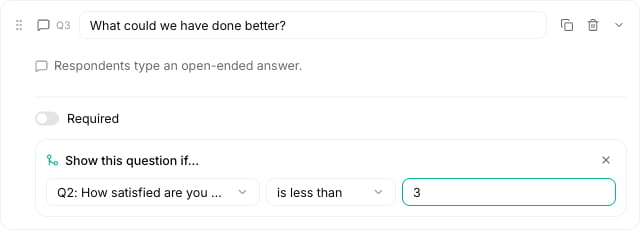
Add display logic to a question
1
Open the question in the editor
In the survey editor, expand the question you want to show conditionally. Make sure it comes after the question its rule depends on; reorder it with the grip handle if needed.
2
Select Add display logic
At the bottom of the question, select Add display logic. If the question is the first one, this is unavailable, because there is no earlier answer to base a rule on.
3
Pick the earlier question
Under Show this question if…, choose one of the earlier questions. Only answerable questions appear here; text blocks are not options, since they collect no answer.
4
5
Save the survey
Save the survey. The inspector’s Conditions count reflects how many questions now have display logic.
How the rules behave
- Earlier questions only. A rule can reference any answerable question above the current one, never one below it. If you move a question above its dependency, review its rule.
- One rule per question. Each question has a single show-if rule. To require several conditions, split the flow across more questions.
- Hidden means skipped. When the condition is not met, the question does not appear for that respondent, and no answer is recorded for it. Hidden questions are simply left out of that person’s response.
- Remove a rule anytime. Open the rule and select the remove (×) control to make the question show for everyone again.
An example
To ask for a reason only from unhappy respondents:- Add a CSAT question: “How satisfied are you?”
- Add a free text question: “What could we do better?”
- On the free-text question, add display logic: show it if the CSAT answer is less than
3.
Next steps
Question types
Pick the answer format each condition works best with.
Create a survey
Build the questions your display logic branches between.
Read survey results
See how conditional answers appear in the response feed.
Share and target a survey
Publish the survey once its logic is set up.