
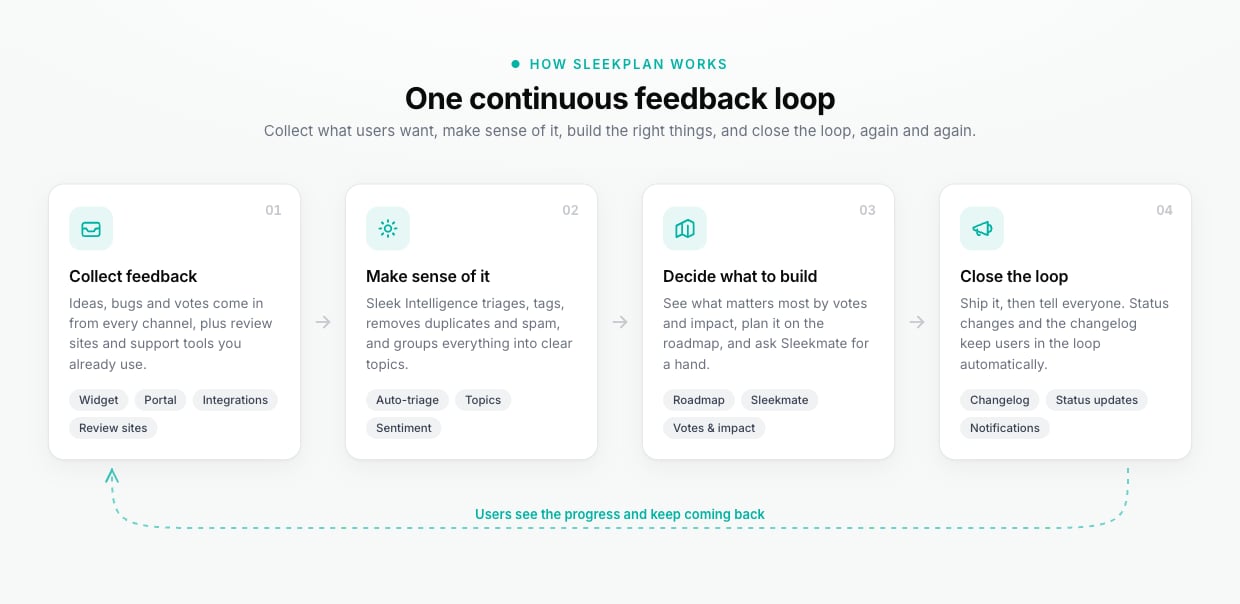
The one idea to remember
Everything in Sleekplan serves a single loop:- Collect feedback from your users, wherever they are.
- Make sense of it so the signal rises above the noise.
- Decide and build the things that will help the most people.
- Close the loop by shipping and letting users know.
How your account is organized
A few words come up everywhere in Sleekplan. Here is what they mean.Sleekplan controls what each person can see and do by their role. Team members work from the admin dashboard; end users only ever see your public board and widget, never your internal tools. Learn more in Account & security.
The modules
Modules are the parts of Sleekplan you turn on for your workspace. Turn on only what you need: you can enable or disable any module from Settings → General at any time.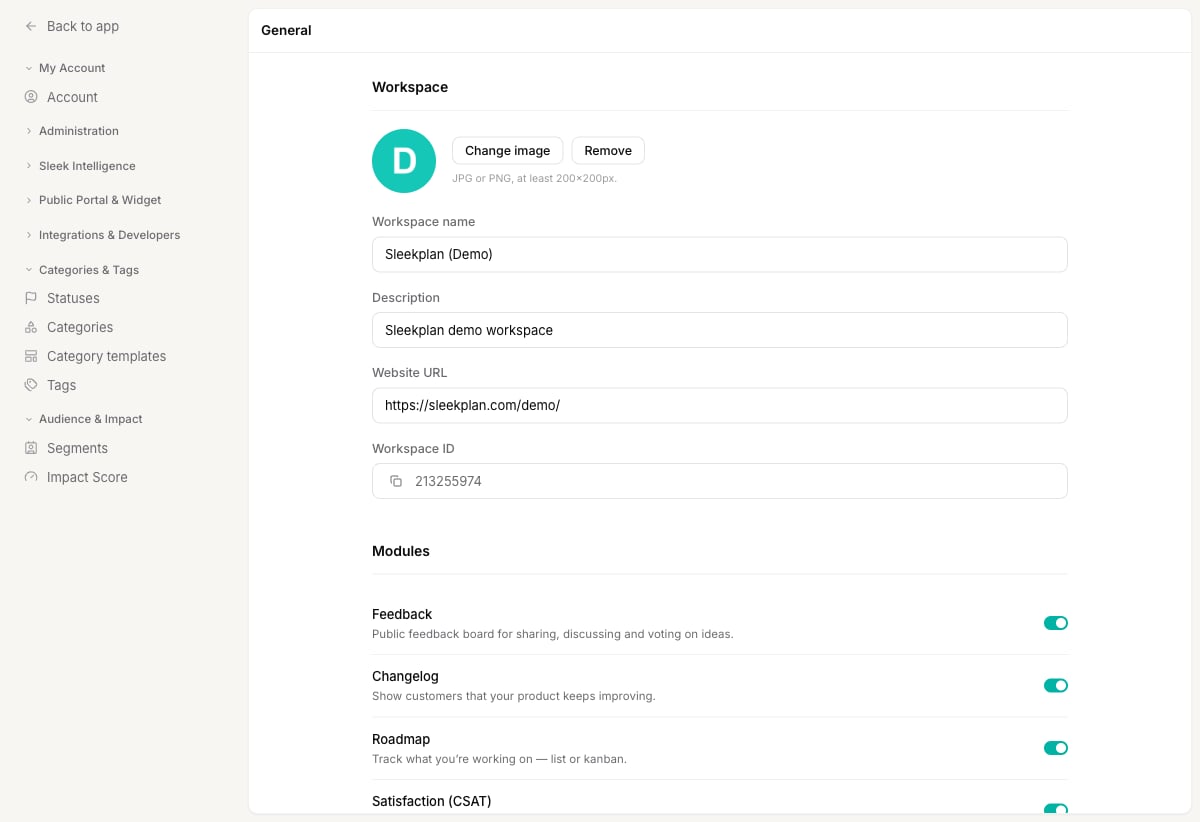
Feedback
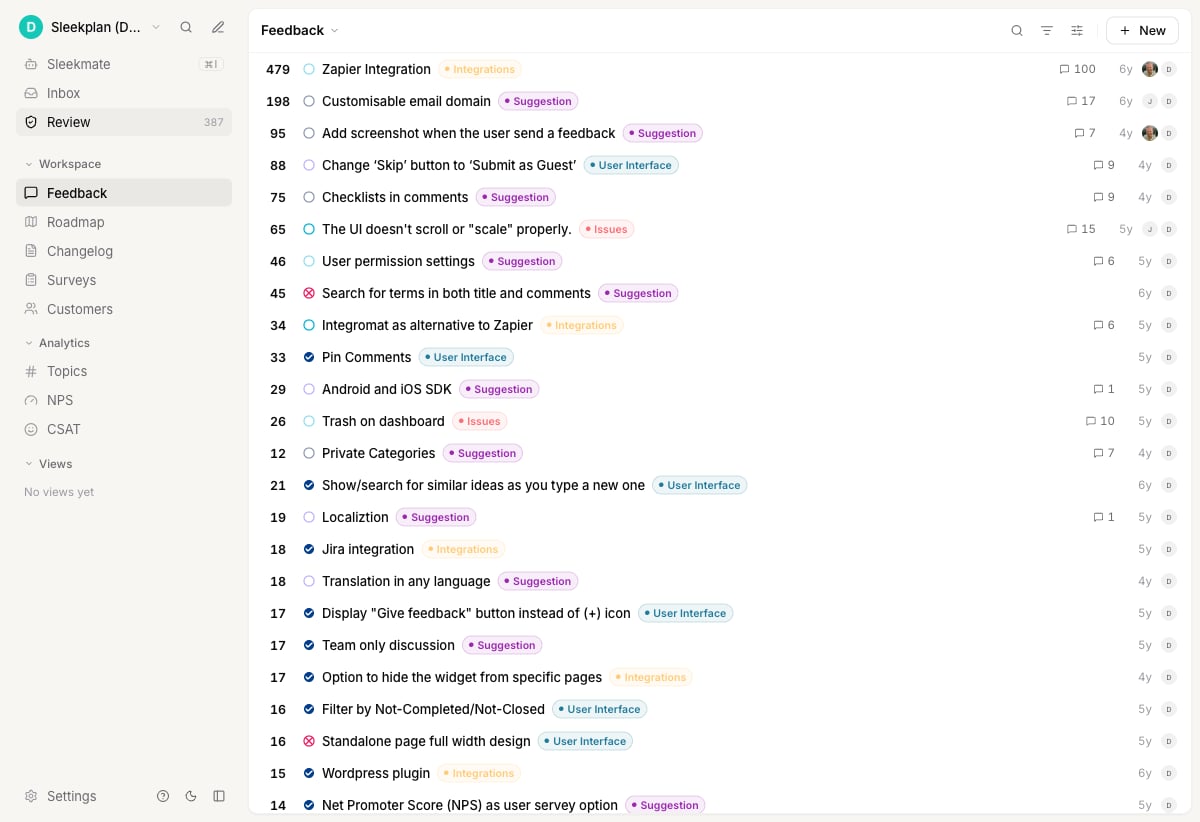
The heart of Sleekplan. A feedback board where users post ideas and bug reports, then vote and comment on each other’s. Votes and discussion show you what your users actually want, ranked by demand instead of by whoever shouted loudest. Each post has a status (its stage in your workflow), a category (the type of feedback), and optional tags for your own organization. You can post on a user’s behalf when feedback arrives by email or on a call. See Create a post and Organize feedback.Roadmap
The roadmap turns your board into a plan. Group posts by status (Planned, In progress, Done) or by timeline (month and quarter) so users can see what you are working on and what is coming next.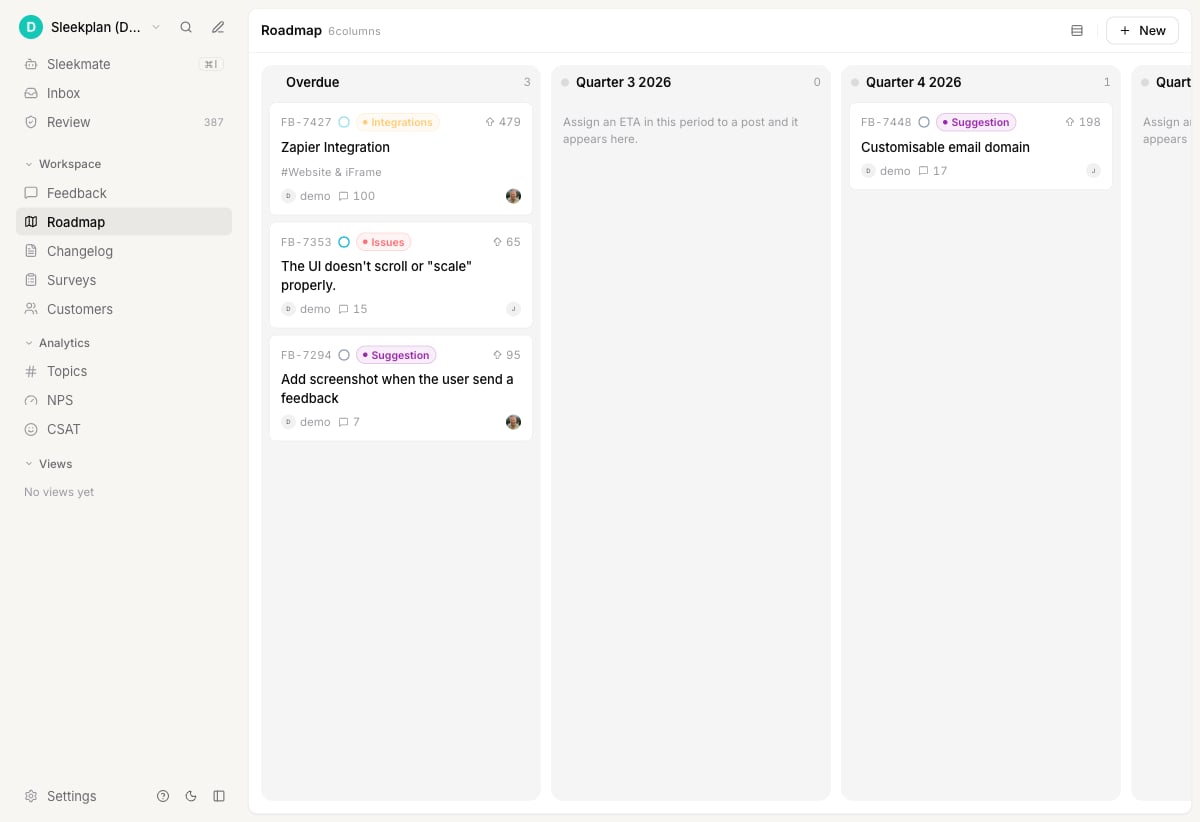
Changelog
When you ship something, announce it in the changelog. It is your product’s “what’s new” feed, and it is how you close the loop: users who asked for a feature or subscribed to updates hear about it the moment it goes live.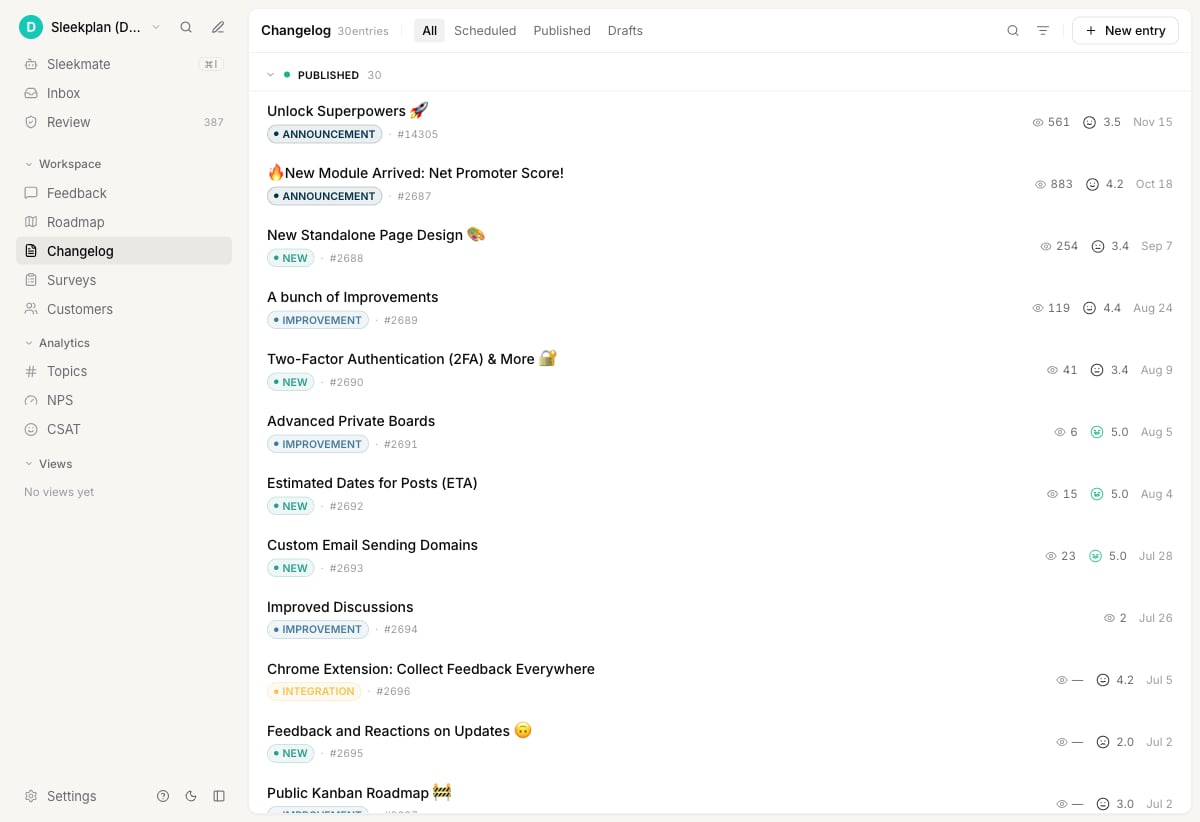
Surveys, NPS and CSAT
Ask users how they feel, right inside your product. Sleekplan includes ready-made NPS (loyalty) and CSAT (satisfaction) surveys, plus multi-step surveys with conditional logic when you need to ask more. Responses flow into the same analytics as the rest of your feedback.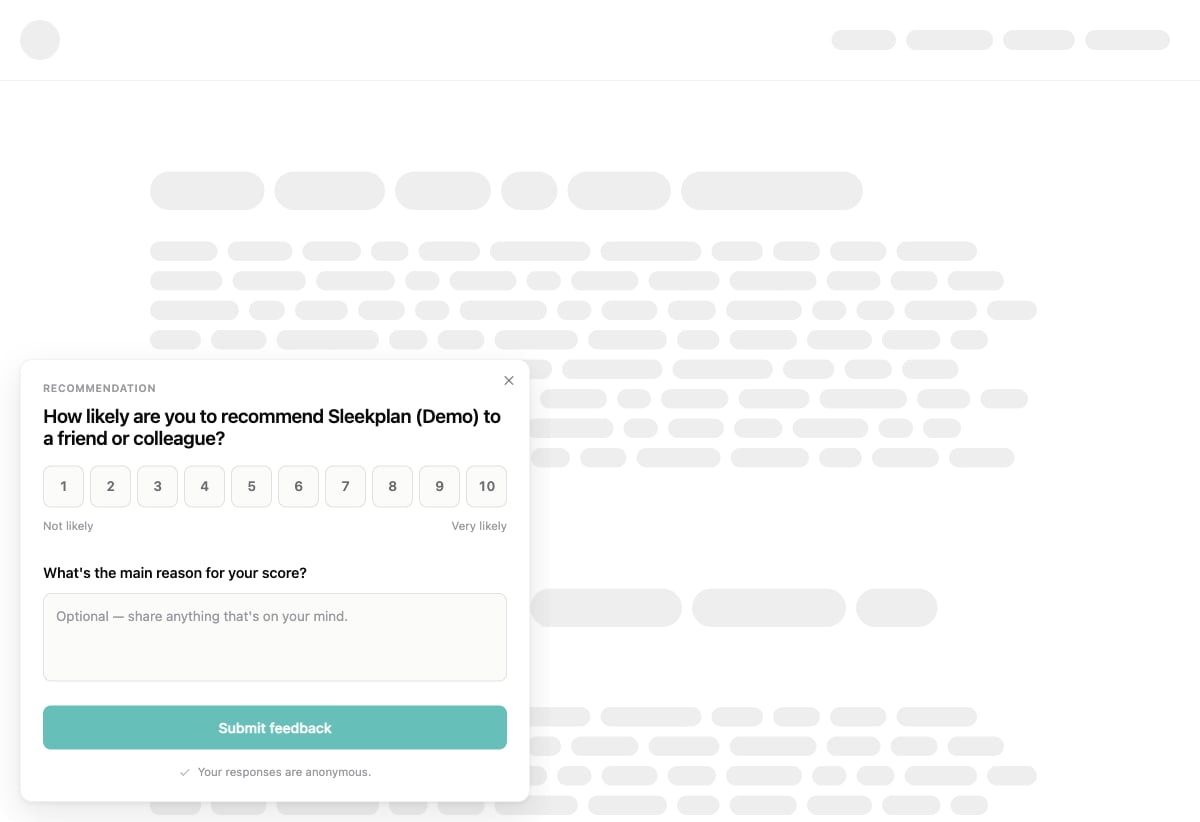
Where your users meet Sleekplan
Your feedback board does not have to live in one place. There are a few ways to put it in front of users, and you can use more than one at once.In-product widget
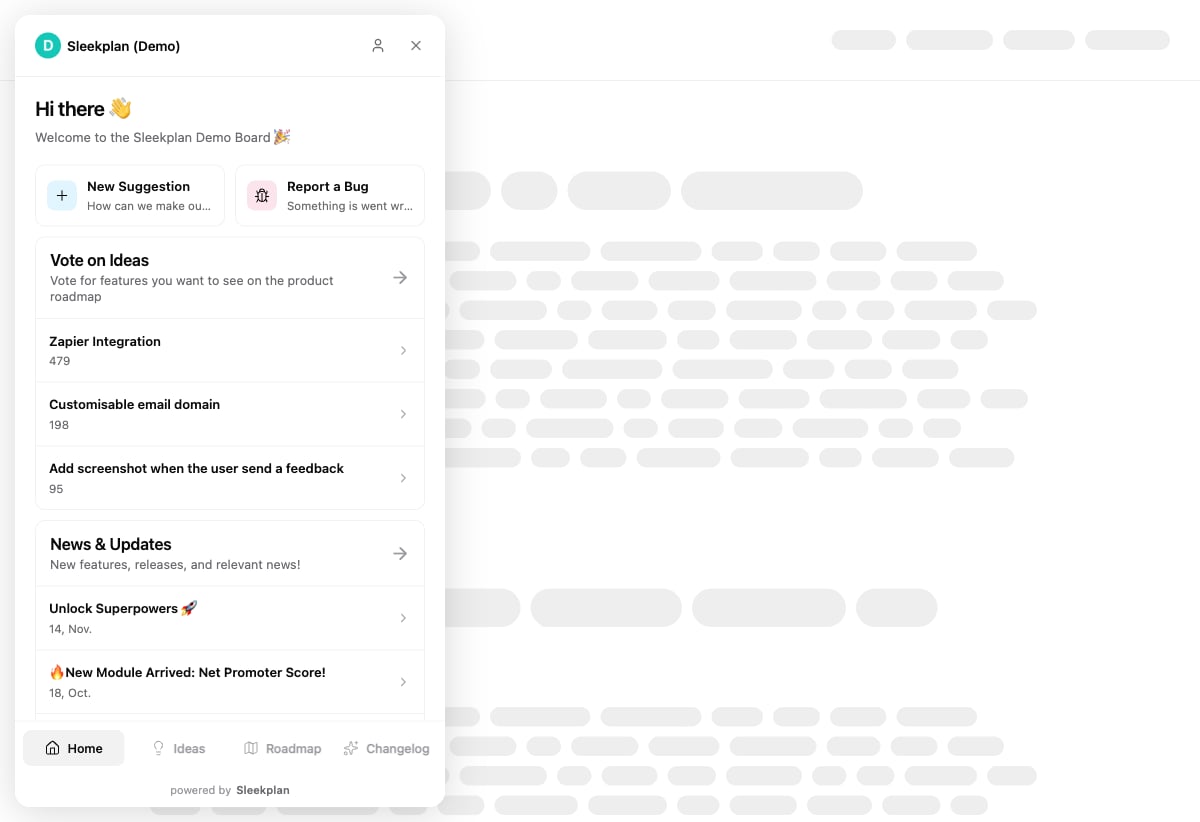
A pop-over panel that lives on a button inside your app or website. Users open it to browse ideas, vote, post feedback, and read your changelog without leaving what they were doing.
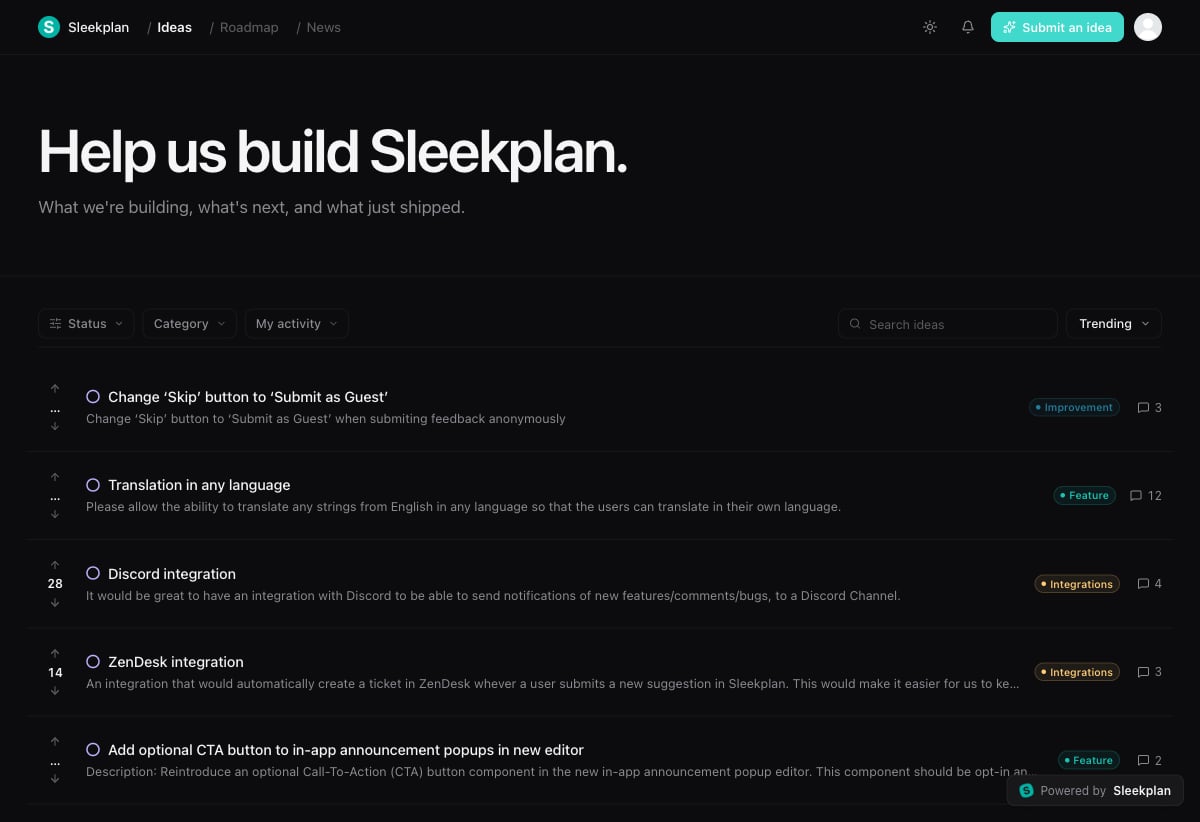
Standalone portal
A hosted, fully branded page (your own web address) that works on its own. It is always available, and every email notification links back to it.
Integrations
Connect the tools your team already uses, so feedback and updates flow between Sleekplan and the rest of your stack.
Embed & links
Drop the board into a page with an iframe, or just share a direct link. Your users always land in the same place.
Sleek Intelligence
Collecting feedback is easy. Keeping up with it is the hard part. Sleek Intelligence is the AI layer built into Sleekplan that reads, sorts and acts on your feedback so your team can focus on decisions instead of admin. You turn it on once, under Settings → Sleek Intelligence, and give it a short description of your product so it has context. From there it powers four things: it brings feedback in, keeps it tidy, groups it into themes, and gives you a copilot to talk to.Sleek Intelligence runs on Intelligence credits, which power AI features like summaries, sentiment analysis, deduplication and the assistant. You can top these up from your billing settings.
Collect feedback from anywhere
Your users leave feedback in a lot of places that are not your board: review sites, app stores, support chats. Sleek Intelligence can pull it all in for you through Sources.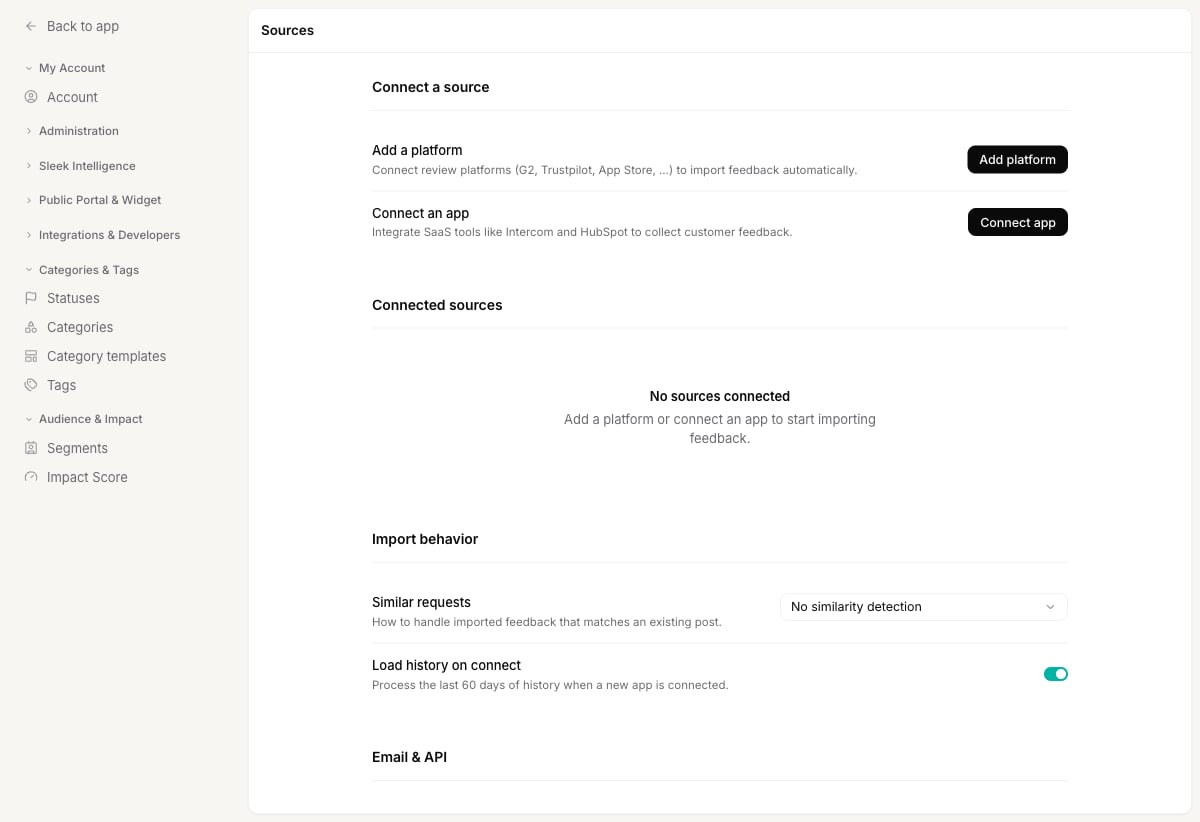
- Add a platform to import from review sites like G2, Trustpilot and the App Store.
- Connect an app such as Intercom or HubSpot to turn support conversations into feedback.
- Email and API let any other tool send feedback straight in.
Manage feedback automatically
New feedback needs triaging before it is useful. Feedback processing can do that first pass for you, on both posts and comments.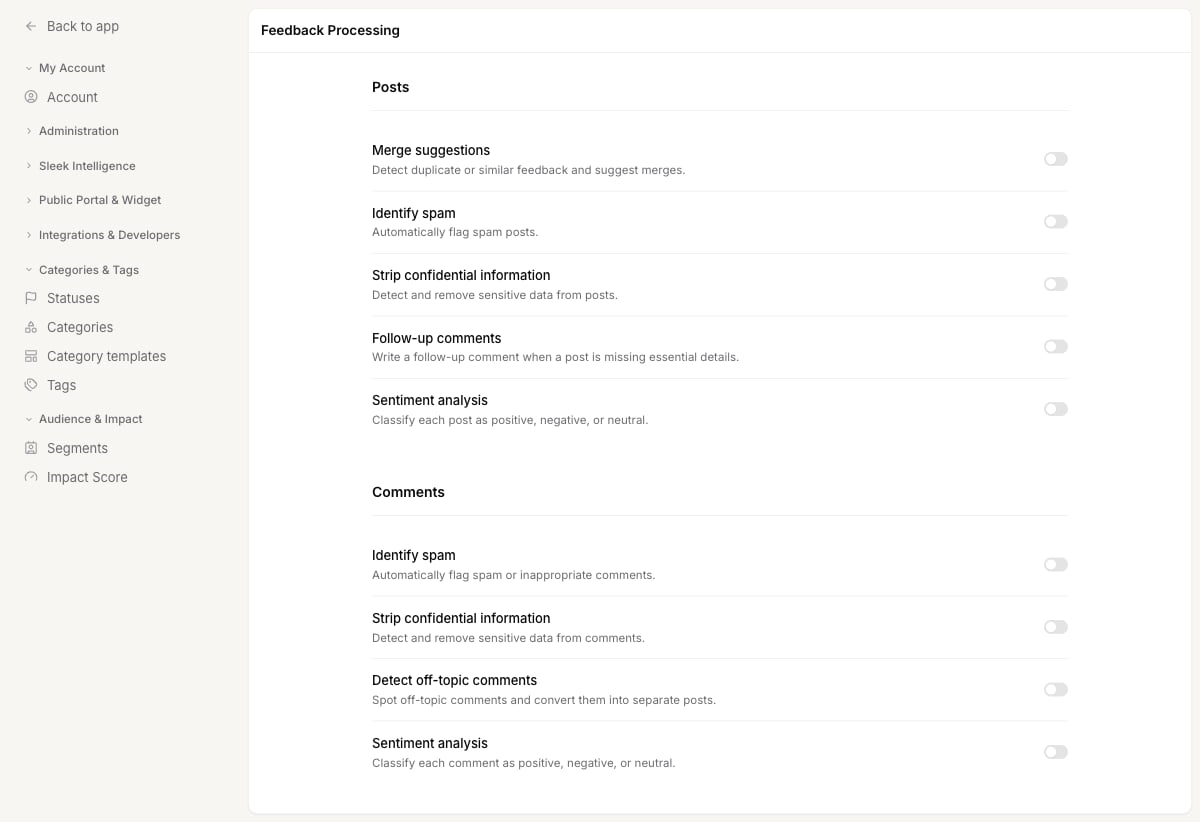
- Merge suggestions spot duplicate or near-identical requests and suggest combining them.
- Identify spam flags junk posts and comments automatically.
- Strip confidential information removes sensitive data before it goes public.
- Follow-up comments ask the user for detail when a post is missing key information.
- Sentiment analysis labels each post and comment as positive, negative or neutral.
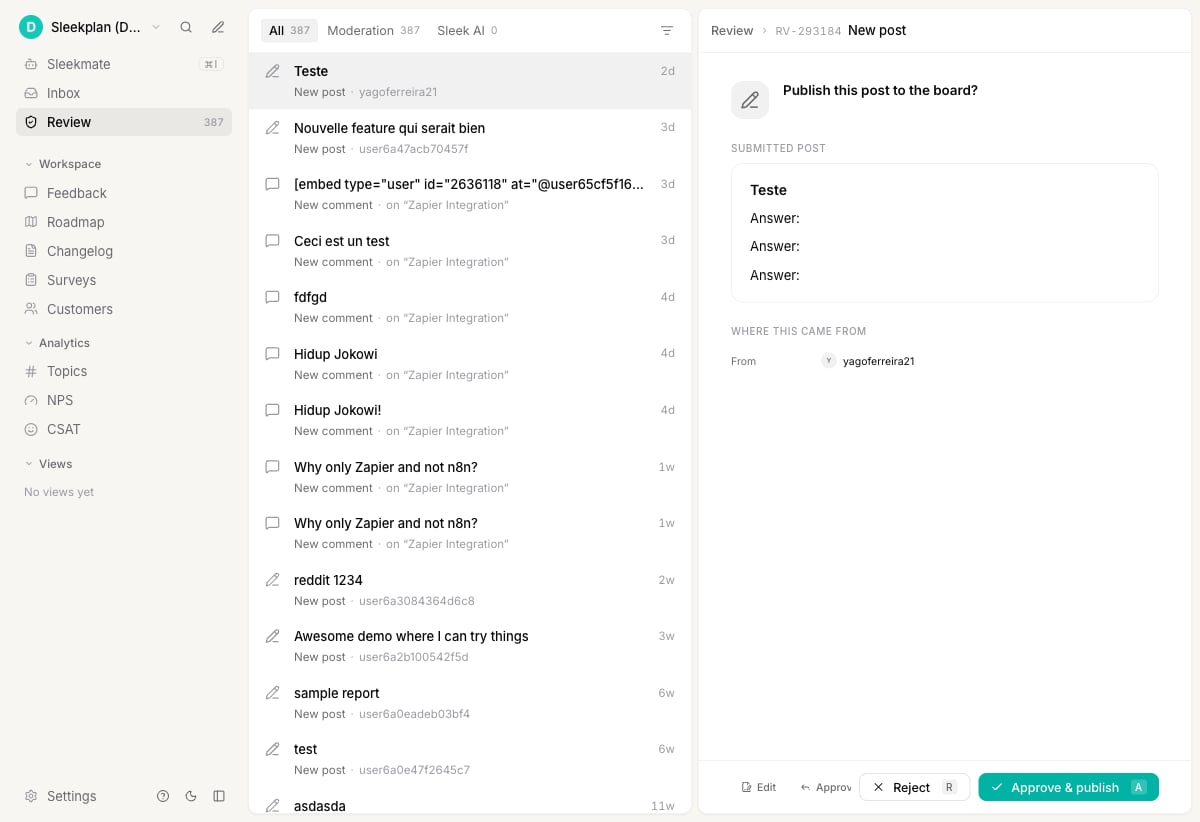
Discover themes with Topics
Hundreds of individual posts are hard to reason about. Topics groups related feedback into themes (and sub-topics), then shows you how each one is trending, how many votes it holds, and whether sentiment is positive or negative. It is the fastest way to answer “what are people really asking us for?”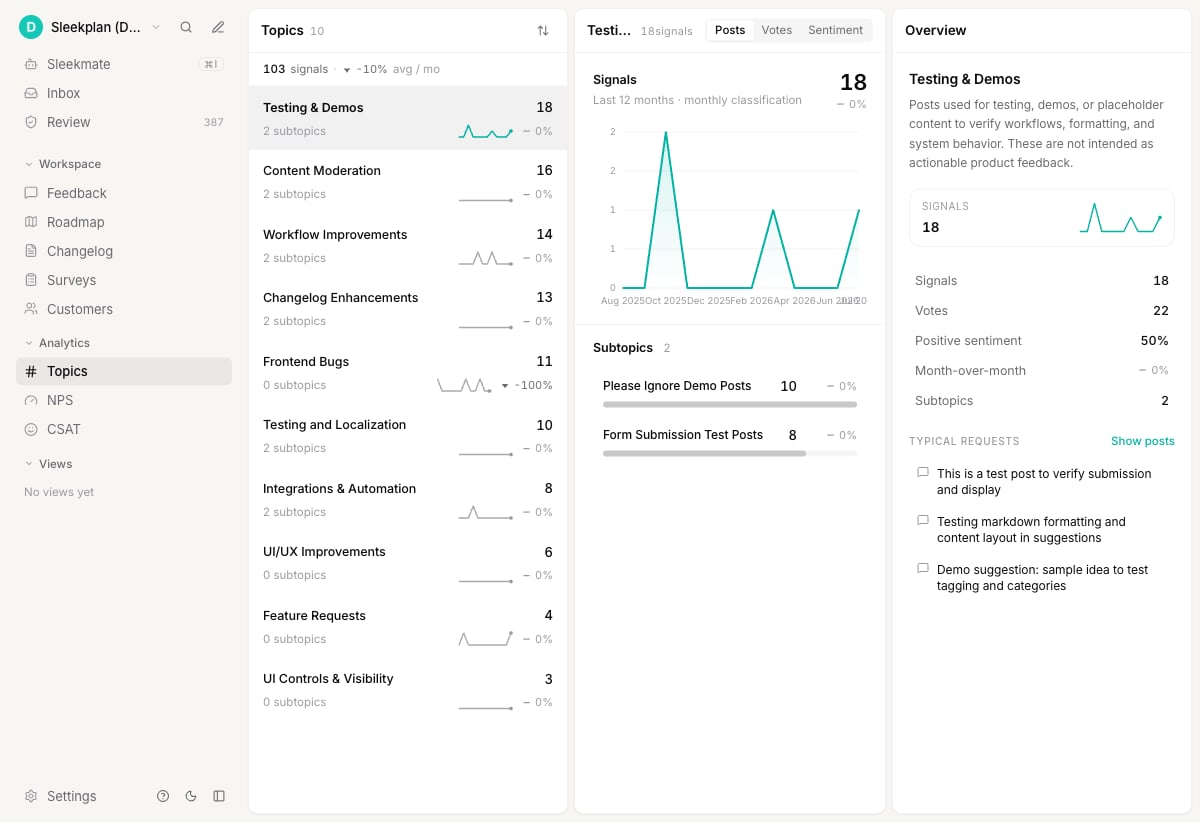
Meet Sleekmate, your product copilot
Sleekmate is a chat assistant that reads your whole workspace, your feedback, roadmap and changelog, so you do not have to dig for answers. Think of it as a product manager sitting next to you.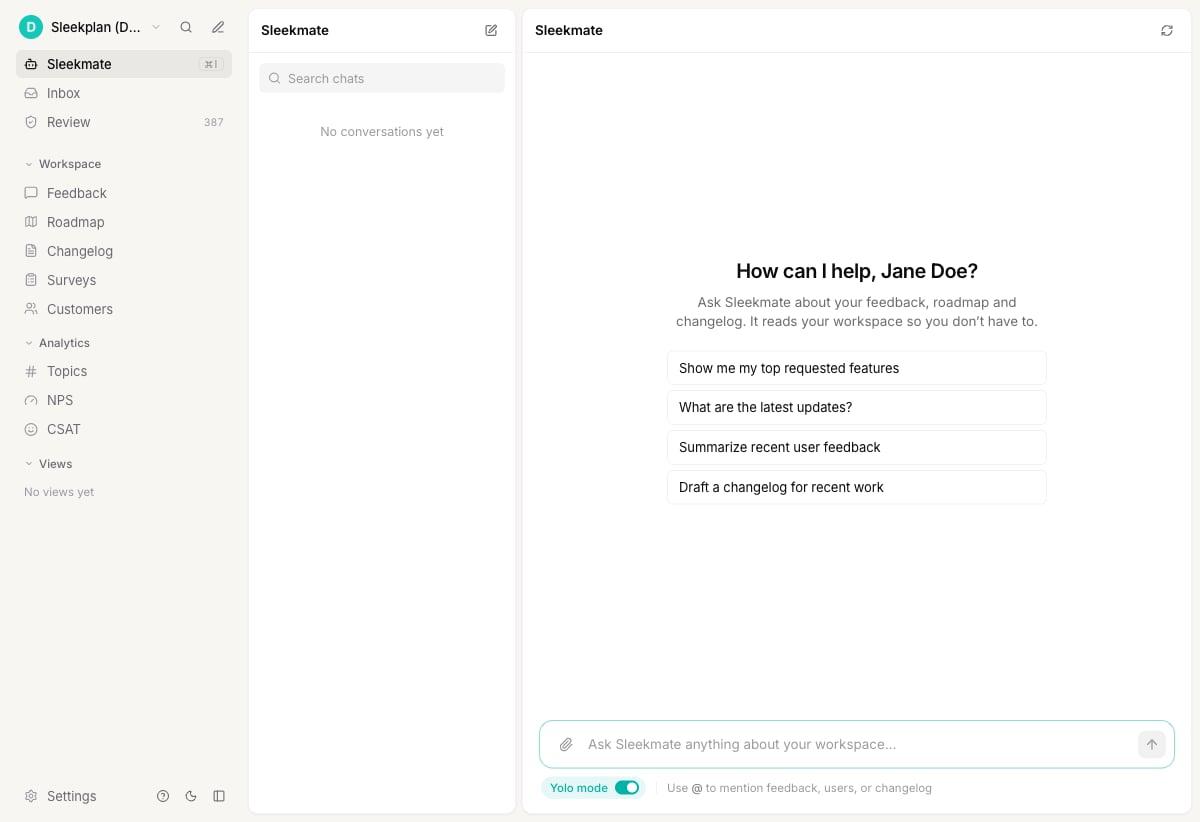
Make it yours
Before you invite users, spend a few minutes on branding so the whole experience looks like your product, not like Sleekplan. Under Settings → Public Portal & Widget → Branding you can set your logo and colors, choose a light or dark theme, rename the modules and buttons, and add the languages your users speak.Get started in four steps
1
Set up your workspace
Add your product name, logo and colors, then turn on the modules you want to start with. Feedback is the natural first one.
2
Put your board in front of users
Install the widget on your site or app, or share your standalone portal link. See Portal & widget.
3
Turn on Sleek Intelligence
Enable it in settings, describe your product, and switch on the automations and sources that fit how you work.
Next steps
Create your first post
Add feedback from the dashboard and set its status, category and owner.
Explore the modules
A closer look at Feedback, Roadmap, Changelog and Surveys.
Set up your portal & widget
Brand your board and choose how users reach it.
Go deeper on Sleek Intelligence
Automations, Topics, Review and Sleekmate in detail.