
Connecting an integration is available to workspace owners and admins. You also need permission to install a GitHub App on the GitHub account or organization that owns your repositories. GitHub is available on every Sleekplan plan.
How the sync works
Once connected, Sleekplan and GitHub stay in step through a few automatic flows. Each one is a setting you can turn off (see Configure the settings):- Sleekplan to GitHub, status updates. When a post’s status changes, Sleekplan updates a matching label on the linked issue and reopens or closes the issue. Setting the post to closed or completed closes the issue on GitHub; any other status reopens it.
- GitHub to Sleekplan, status updates. When you add a label to a linked issue whose name matches one of your Sleekplan statuses, the linked post moves to that status.
- GitHub to Sleekplan, automatic post creation. When a new issue is opened in a connected repository, Sleekplan creates and links a feedback post for it, filed under the category you choose.
- Automated message and locking. When a post is linked to an issue, the Sleekplan bot adds a comment on the issue with a link back to the post, and can lock the issue so the conversation stays on your board.
Connect GitHub
1
Open the Integrations screen
Go to Settings → Integrations. In Settings, it lives in the left sidebar under Integrations & Developers. Find Github in the All integrations list and click Connect.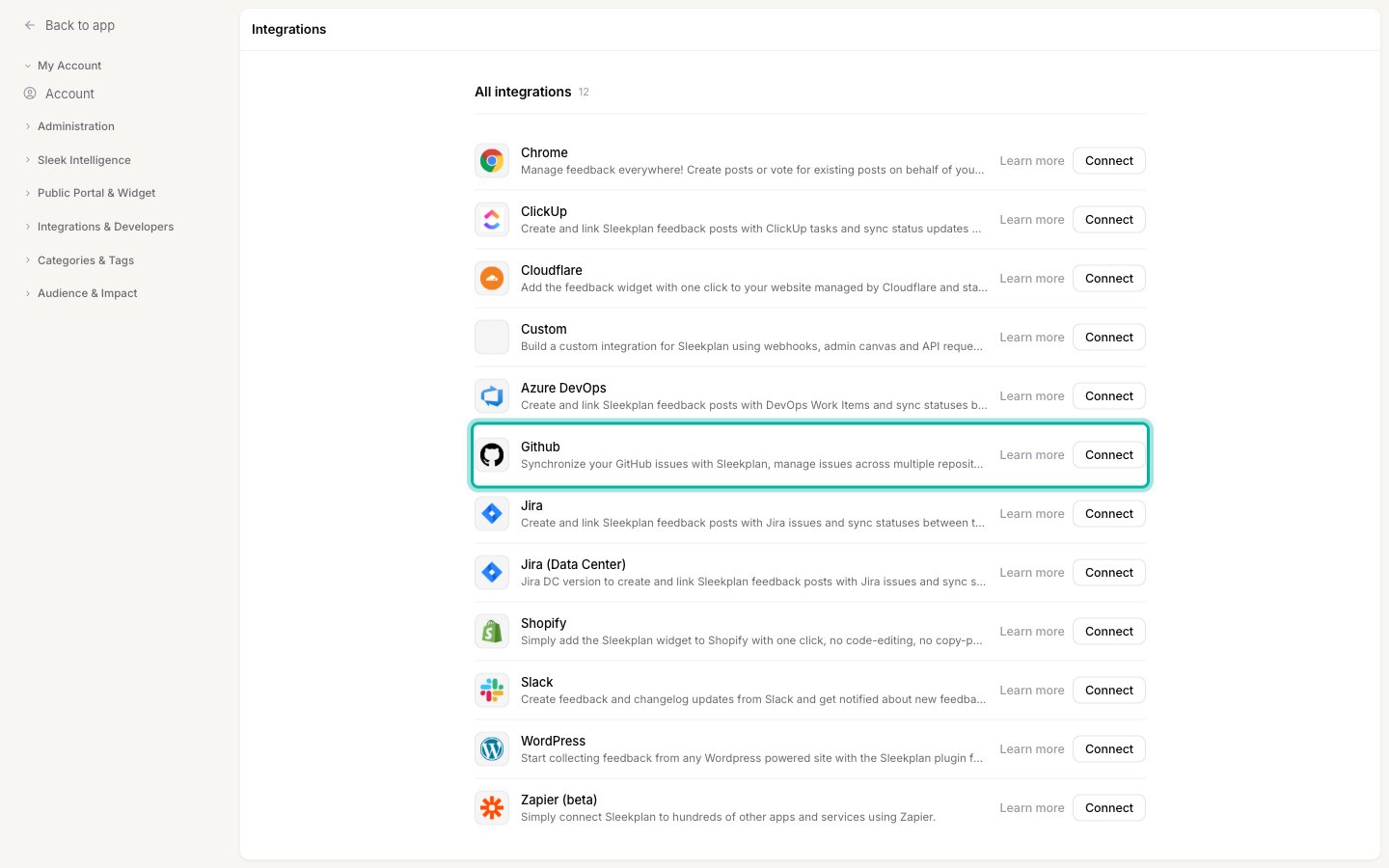
2
Install the Sleekplan GitHub App
Sleekplan opens the Sleekplan GitHub App installation page on GitHub in a new tab. Choose the GitHub account or organization that owns your repositories, then pick which repositories the app can access. You can grant all repositories or select individual ones. Only the repositories you grant here can be searched, linked, or used to create issues later.
3
Approve and return to Sleekplan
Confirm the install on GitHub. GitHub sends you back to Settings → Integrations, where Github now appears in the Connected section. Sleekplan pulls in the repositories you granted access to automatically.
A GitHub App installation can be connected to one Sleekplan workspace at a time. If you try to connect an installation that is already linked to another workspace, the connection is rejected. To move it, disconnect it from the other workspace first.
Configure the settings
Open Settings → Integrations, find Github in the Connected section, and click Manage to open its settings. Every sync behavior is optional and can be toggled here.
The automated message supports two placeholders you can drop into the text:
{{LINK}}inserts the public link to the feedback post (on your board).{{ADMIN_LINK}}inserts the admin link to the post inside Sleekplan.
Link a feedback post to a GitHub issue
Beyond the automatic flows, you can connect any post to an issue by hand from the post itself. Open a feedback post and use the GitHub panel to search, create, and link issues.1
Open a feedback post
In the admin, open the feedback post you want to link. The GitHub panel appears on the post with a search box and a Create new issue button.
2
Link an existing issue or create a new one
Type a search term to find an existing issue across your connected repositories, then pick it from the results to link it. To make a new issue instead, click Create new issue, enter a title and description, and choose the repository to create it in.
3
Confirm the link
Once linked, the panel shows Issue # with a link to the issue on GitHub, and the Sleekplan bot adds its automated comment (and locks the issue, if that setting is on). To break the connection, click Unlink issue.
When Sleekplan creates a new issue from a post, it only attaches a status label if a matching label already exists in that repository. GitHub rejects issue creation when a label is missing, so status sync simply starts working once the label exists.
Disconnect GitHub
Open Settings → Integrations, find Github under Connected, click Manage, then click Disconnect. This stops all syncing and removes the connection from this workspace. Existing GitHub issues and Sleekplan posts are left in place; they simply stop updating each other.Related
Feedback statuses
See how statuses map to the labels GitHub syncs.
Categories
Set the category new posts from GitHub land in.
Create a feedback post
The posts you link issues to.
All integrations
Browse everything you can connect to Sleekplan.