
Directory Sync needs the SAML single sign-on add-on on a Business plan. Only Owners and Admins can add or remove connections. See Team roles and permissions.
Choose which directory you need
Sleekplan has two separate groups of people, and a directory connection serves one of them. Decide which before you start, because they do very different things.Backend
Your team: the colleagues who sign in to the Sleekplan dashboard to triage feedback and publish updates. Syncing here creates and removes team seats.
Frontend
Your portal users: the customers and staff who vote, post, and comment on your board. Syncing here creates and removes those end-user records.
Team seats cost money and portal users do not. A backend directory that pushes your entire company will try to give every one of those people a paid seat. Scope it to the group that actually needs dashboard access.
Connect a directory
1
Open Access Management
Go to Settings → Access Management. SAML connections are listed at the top and Directory Sync below them.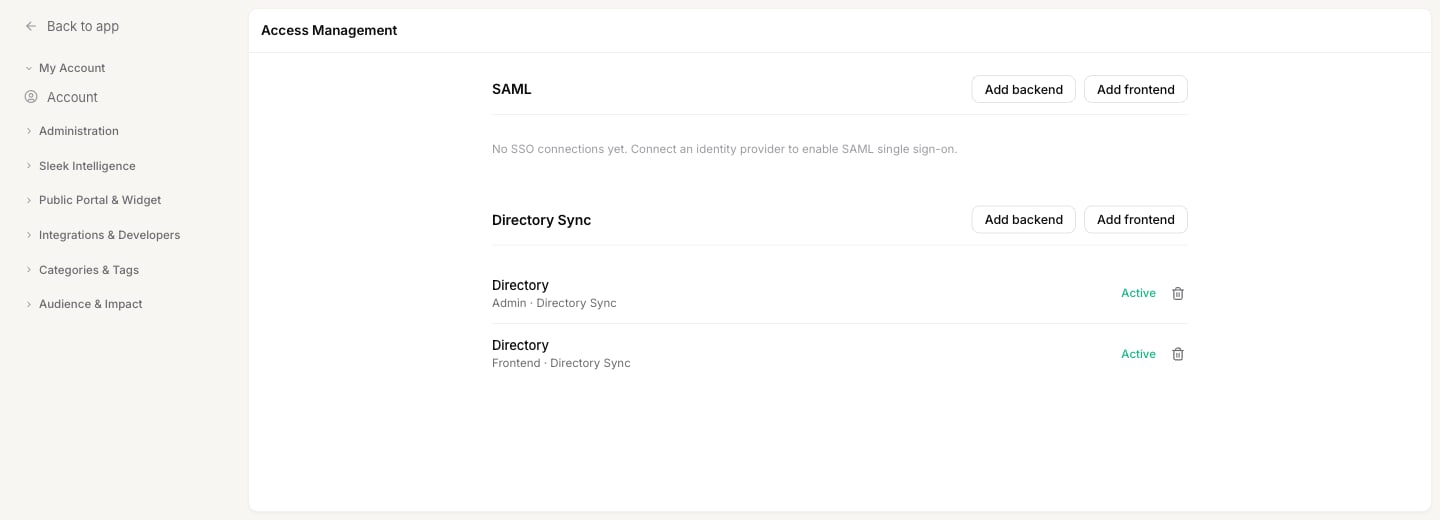
2
Start the setup
In the Directory Sync section, click Add backend for your team, or Add frontend for your portal users.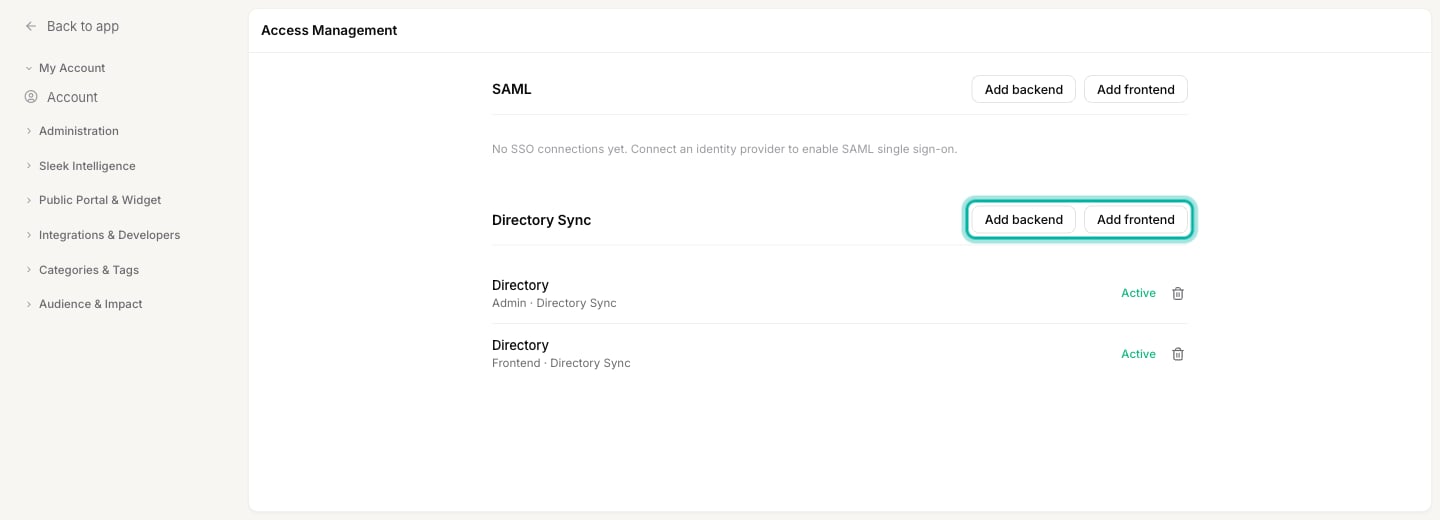
3
Finish setup at your provider
A setup page opens in a new tab with instructions for your provider, along with the SCIM endpoint and the token you need. Copy both into the provisioning settings of your Sleekplan app in Okta, Entra ID, or whichever directory you use.The setup link is valid for 7 days. If it expires before you finish, come back to this page and click the button again to get a fresh one.
4
Check it connected
Close the setup tab and return to Sleekplan. The new connection appears in the Directory Sync list marked Active. If it does not show up, reload the page.
Choose who gets synced
Sleekplan syncs whoever your provider sends, so you decide the scope in your provider rather than here. In Okta, Entra ID, and OneLogin, you assign the Sleekplan app to specific users or groups. Only assigned people are pushed. If you want just your support and product teams in the dashboard, assign the app to those two groups and nobody else arrives. There is no group list to manage inside Sleekplan, and group names are not stored. Sleekplan reacts to people being added to or removed from a group your provider already syncs, which is why changing the assignment in your provider is all you need to do.What happens when your directory changes
Backend directories (your team)
New people always arrive as Members. To make someone an Admin, change their role in Sleekplan after they are synced. Your directory will not overwrite it.
Two things are deliberately protected. A workspace Owner is never removed by a directory, so losing access to your provider cannot lock you out of your own workspace. And if you are at your seat limit, the extra person simply is not added, rather than your bill going up on its own. Book more team seats if you need the room.
Names and email addresses on existing accounts are left alone. A Sleekplan account can belong to several workspaces, so the profile belongs to the person rather than to your directory.
Frontend directories (your portal users)
Attributes become segments
This applies to frontend directories only. Anything you map in your provider beyond name and email is stored on the portal user, in the same place the widget SDK stores custom data. That means a mappeddepartment can become a user segment, so you can filter your board by department without maintaining a single list by hand. Job title, office, and employee type work the same way.
It takes two steps, because Sleekplan needs to know an attribute exists before it can offer it as a condition:
1
Map the attribute in your provider
In the provisioning settings of your Sleekplan app, add the attribute to the list your provider pushes. Nothing beyond name and email is sent until you map it.
2
Add a matching custom field
In Settings → Segments, add a custom field whose Identifier is the attribute name in lowercase, such as
department. The field then appears in the segment condition builder.- Attribute names arrive in lowercase. Whether your provider sends
Departmentordepartment, use department as the identifier. - Only single values are stored. Lists such as group memberships or multiple phone numbers are skipped, because a segment compares one value.
- Passwords are never stored, even if your provider is configured to send them.
Remove a directory connection
Click the trash icon on the connection and confirm. Sleekplan stops receiving changes from that directory immediately. Removing a connection does not remove the people it created. Team seats and portal users stay exactly as they are, they just stop being kept up to date. If you want those people gone, remove them in Sleekplan as well, from Settings → Team for teammates or from your users list for portal users. Directory connections cannot be edited. If something needs to change, remove the connection and add it again.When something does not sync
- Nobody appears after setup. Check that the Sleekplan app is assigned to the right users or groups in your provider. Nothing is pushed until it is assigned.
- One person is missing. Someone with a pending invitation is skipped, since that invitation already reserves their seat. They join when they accept it.
- New teammates stopped appearing. You are probably at your seat limit. Book more team seats.
- Someone came back as a new portal user. That is expected after a suspension. See the warning above.
Related
Add-ons
Book the SAML single sign-on add-on and extra team seats.
Team roles and permissions
What Owners, Admins, and Members can each do.
Set up user segments
Turn synced attributes such as department into segments.
Control who can access your board
Pick how visitors sign in, including Enterprise SSO.