
Schedules run on Sleekmate, so Sleekmate must be turned on for your workspace and your plan must include AI (Starter and above). Each run uses Intelligence credits, just like a message you send yourself.
Create a schedule
1
Open Schedules and start a new one
Go to Settings → My Account → Schedules and click New schedule.
2
Name it
Give it a short, descriptive name, for example “Weekly feedback digest”. The name is also the title of every conversation the schedule starts, so you can spot its runs in Sleekmate.
3
Write the instructions
Describe what Sleekmate should do on every run, the same way you would ask it in the chat. Markdown works.
4
Choose when it runs
Under Trigger, pick On a schedule to run it at set times, or When something happens to run it on an event in your workspace. Both are explained below.
5
Decide whether it may make changes on its own
Leave Run without approval off to approve every change yourself. See Approving what a run changes.
6
Pick its connectors
If you’ve added connectors, like Linear or Notion, they’re listed under Connectors, all switched on. Switch off the ones this schedule doesn’t need.
7
Save it
Click Create schedule. A new schedule is Active right away.
Run on a schedule
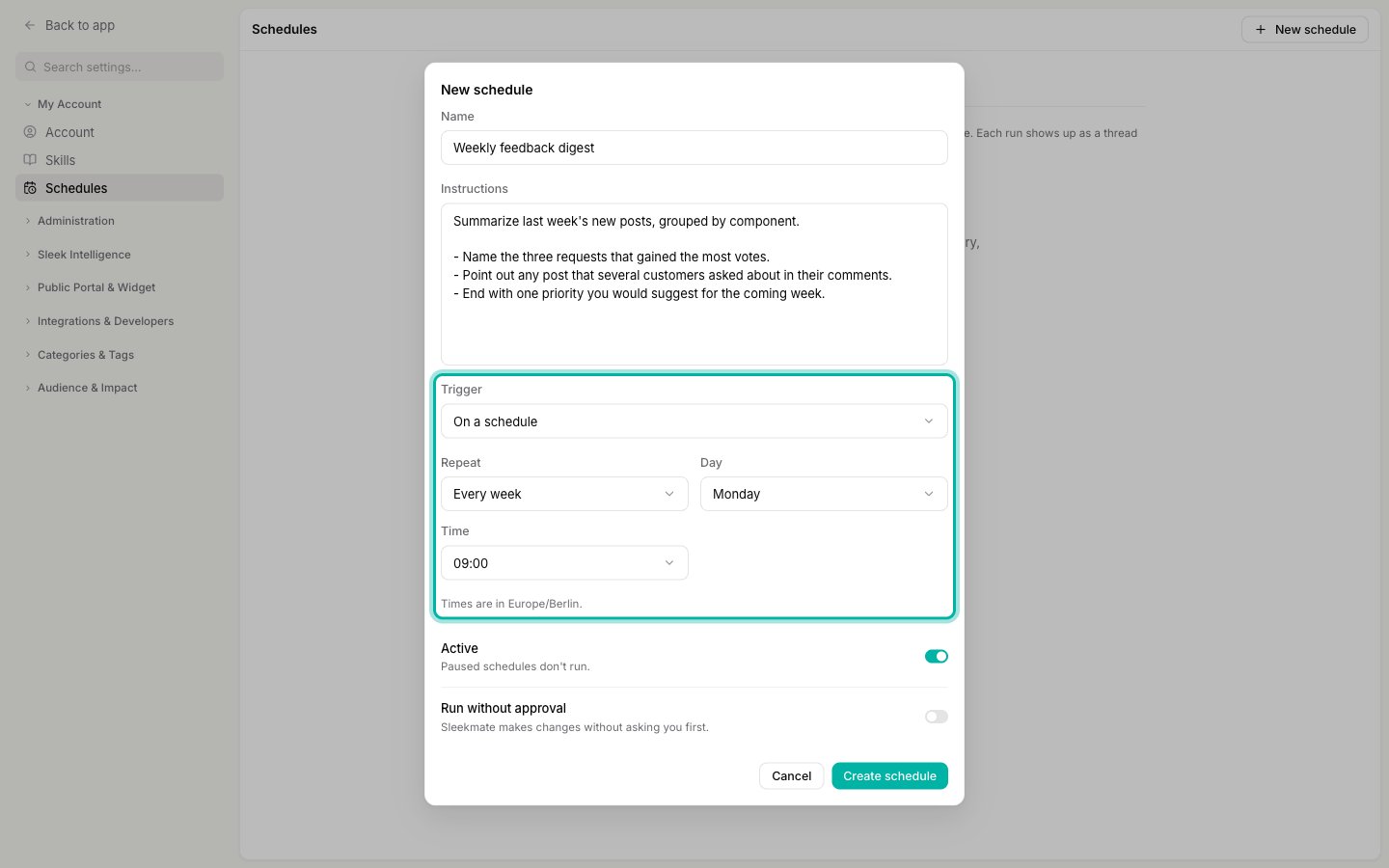
With On a schedule, choose how often it repeats:
Times are offered in 15-minute steps and use the timezone shown under the fields, for example “Times are in Europe/Berlin.” A new schedule takes your browser’s timezone. If you open a schedule that uses a different timezone, click Use my timezone to switch it to yours.
Run when something happens
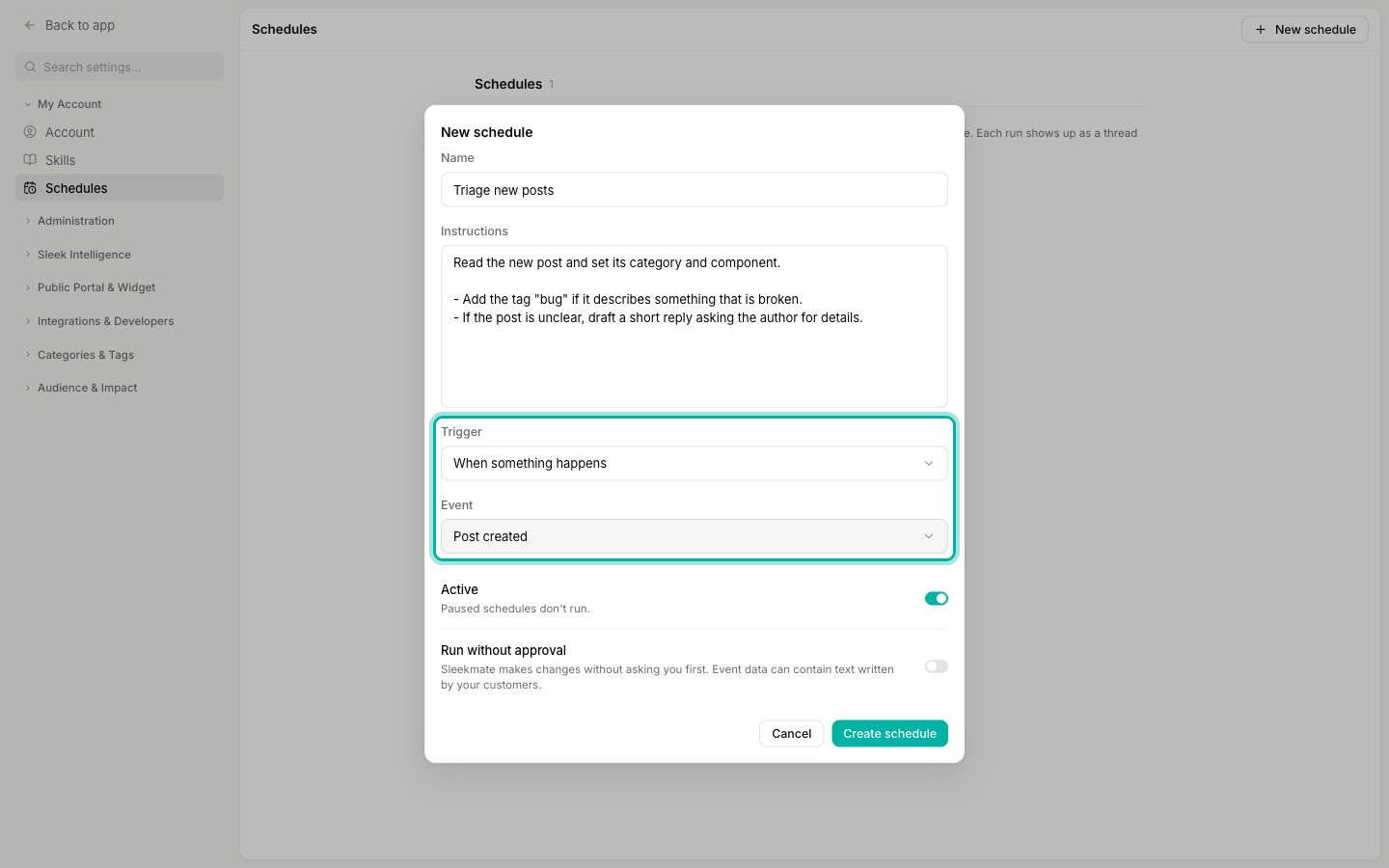
With When something happens, choose the Event that starts a run:
These are the same events a webhook can listen to.
- One run per event. The same event starts a schedule at most once within 10 minutes, and a schedule runs at most 20 times per hour. Events beyond that are skipped, and the schedule shows Some events skipped.
- No loops. Changes a scheduled run makes don’t start your schedules again, so a schedule that edits posts can’t keep triggering itself.
- Imports don’t count. Posts, changelog entries and customers brought in with an import don’t start schedules.
- Deleted items. For Post deleted, Comment deleted and Customer deleted, the run starts after the item is gone, so Sleekmate only has the data from the event itself.
Approving what a run changes
By default, a scheduled run asks before it changes anything, exactly like the chat. When Sleekmate wants to create, edit, merge or delete something, the run pauses with an approval card in its conversation. In your Sleekmate conversation list, the run shows Waiting for your approval. Open it and approve or reject the change whenever you get to it: the card waits for you. If you turn on Run without approval, Sleekmate makes its changes right away without asking, like Yolo mode in the chat. That includes changes in your connected apps.Run a schedule now
To test a schedule, or to run it outside its usual time, open it and click Run now. You’ll see “Run started. It shows up in Sleekmate in a moment.” and the run appears in your Sleekmate conversation list.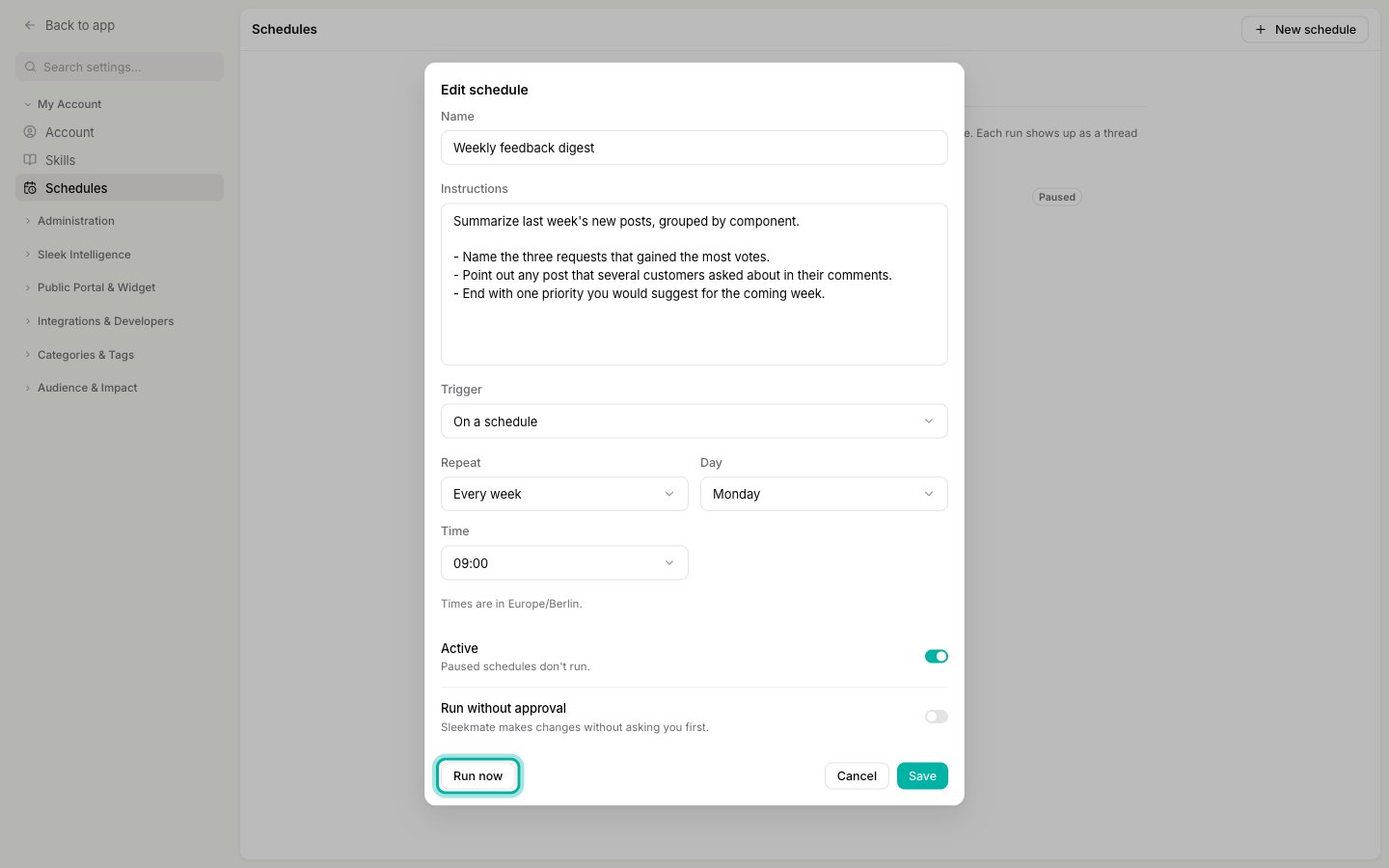
Manage your schedules
The Schedules page lists your schedules with when each one runs, for example “Every Monday at 09:00” or “When: Post created”.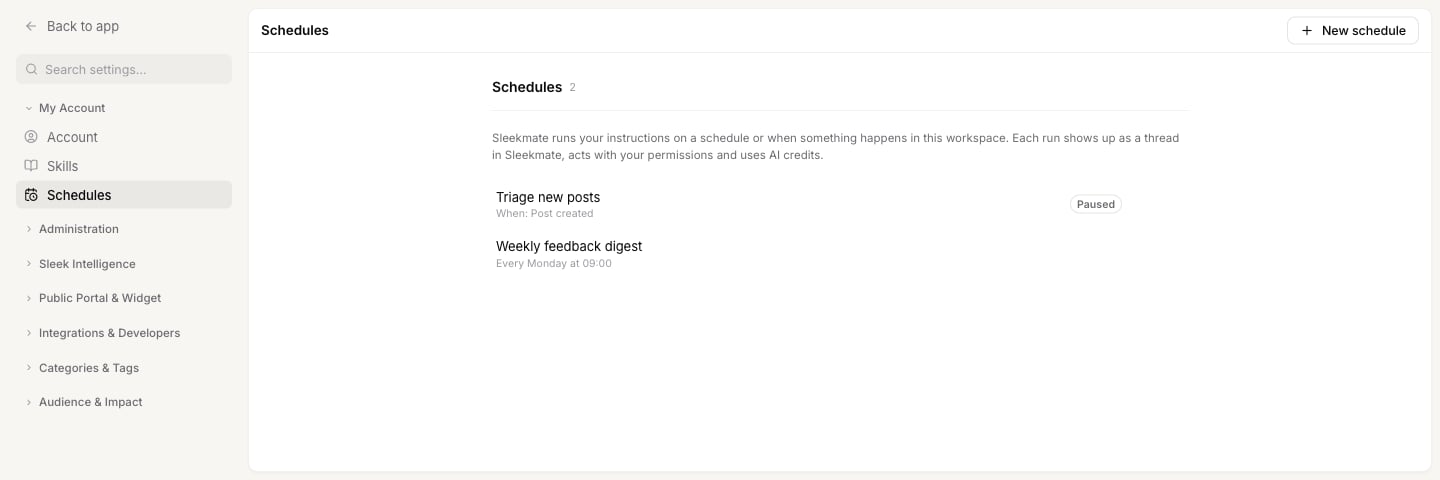
- See the last run. A row shows when the schedule last ran, for example “Ran 2 hours ago”. Open the schedule and click Open thread to jump to that conversation.
- Pause a schedule. Open it, turn off Active and click Save. A paused schedule shows Paused and doesn’t run until you turn it back on.
- Edit or delete. Hover a row and click Edit or Delete. Deleting asks you to confirm.
When a run didn’t start
A row that shows Last run failed has a reason in the schedule itself. Open it to see the message at the top:
The schedule stays active in all of these cases.
If you leave the workspace, or your seat is deactivated, your schedules pause with “Paused: you no longer have access to this workspace.” so nothing runs in your name. Turning a paused schedule back on clears the message.
Limits
- Up to 20 schedules per person in each workspace.
- A name can have up to 100 characters and the instructions up to 5,000.
- Run now can start up to 10 runs per 10 minutes. Past that, you’ll see “Too many runs started. Try again in a few minutes.”
- An event schedule runs at most once per event within 10 minutes, and at most 20 times per hour.
Related
Sleekmate
The copilot that runs your schedules, and where every run shows up.
Skills
Write down how a task should be done once, and every run can follow it.
Sleek Intelligence credits
How runs use credits and how to top up.
Team roles and permissions
What owners, admins, and members can each do.