# Why MCP Servers now matter for Product Management
Product managers live in tabs. An MCP Server cuts through that noise. It lets a Product Manager ask one question and get context from user feedback, roadmaps, issues, analytics, and releases in one place. If you care about user feedback and clear Product Management flow, MCP is your new backbone.
# What the Model Context Protocol actually does
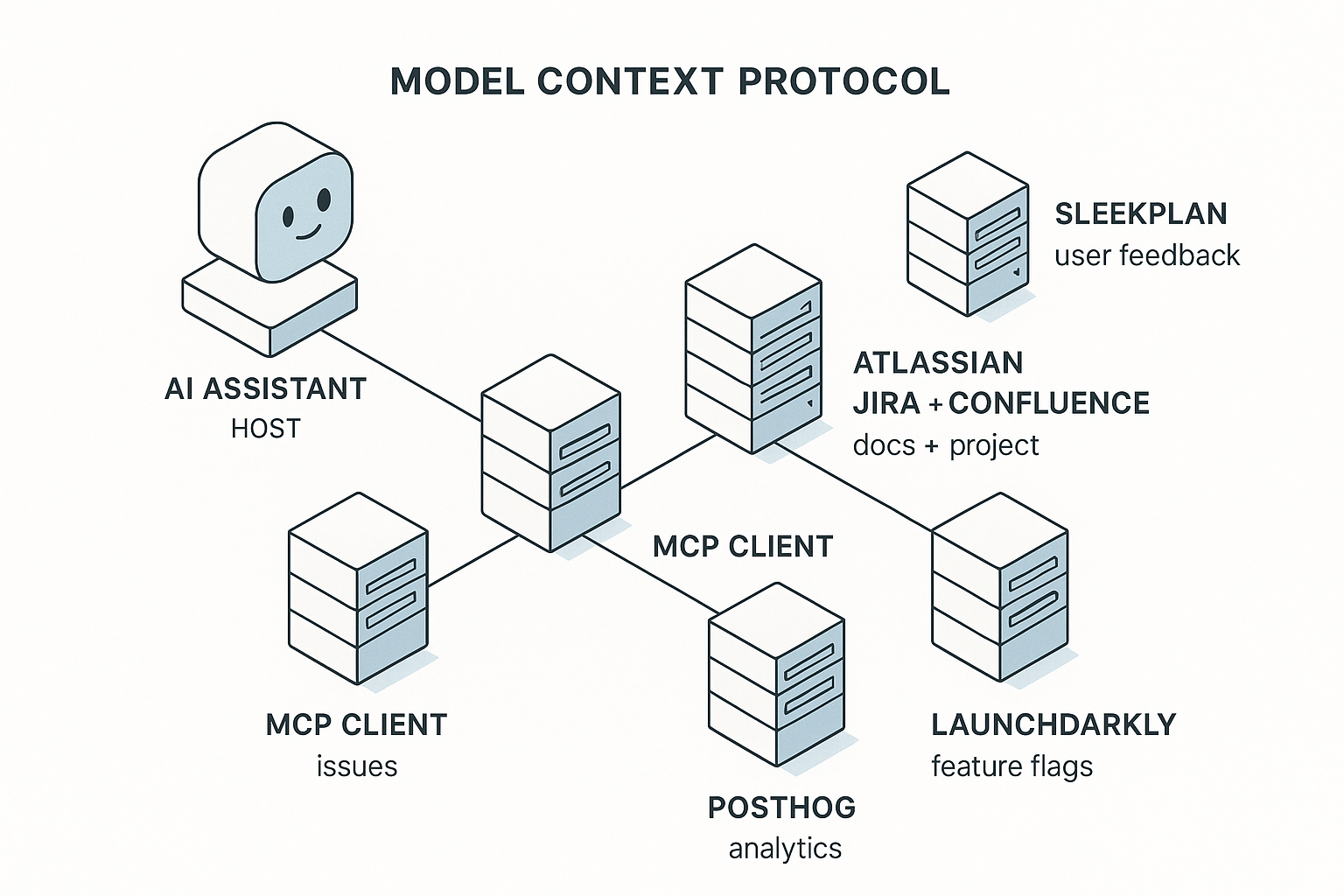
MCP gives AI assistants a safe, standardized way to talk to your tools. Instead of custom connectors for each pair of apps, MCP exposes capabilities through a universal interface. That means your assistant can search docs, create issues, check analytics, or tweak flags without brittle glue code. Read the core design here: MCP server concepts (opens new window) and a practical overview from Snyk’s guide to MCP servers for product managers (opens new window).
The value is simple: less context switching, more judgment. You keep steering, the assistant pulls the threads together.
# Sleekplan, the feedback source of truth
Great Product Management starts with user feedback that is easy to capture and harder to ignore. Sleekplan centralizes it, turns noise into patterns, then closes the loop with roadmaps and updates.
- Collect feedback where it happens with the in‑product widget: see the feedback widget (opens new window).
- Structure the backlog with voting and themes: use the feature request tool (opens new window).
- Share what’s next and what shipped: explore Sleekplan features (opens new window) and our Changelog features (opens new window).
- Bring signals into your stack: see key integrations (opens new window).
A crisp workflow we like: auto-tag enterprise requests, auto-link duplicates, create an issue when a request passes a vote threshold, ship, then post a changelog entry within 24 hours.
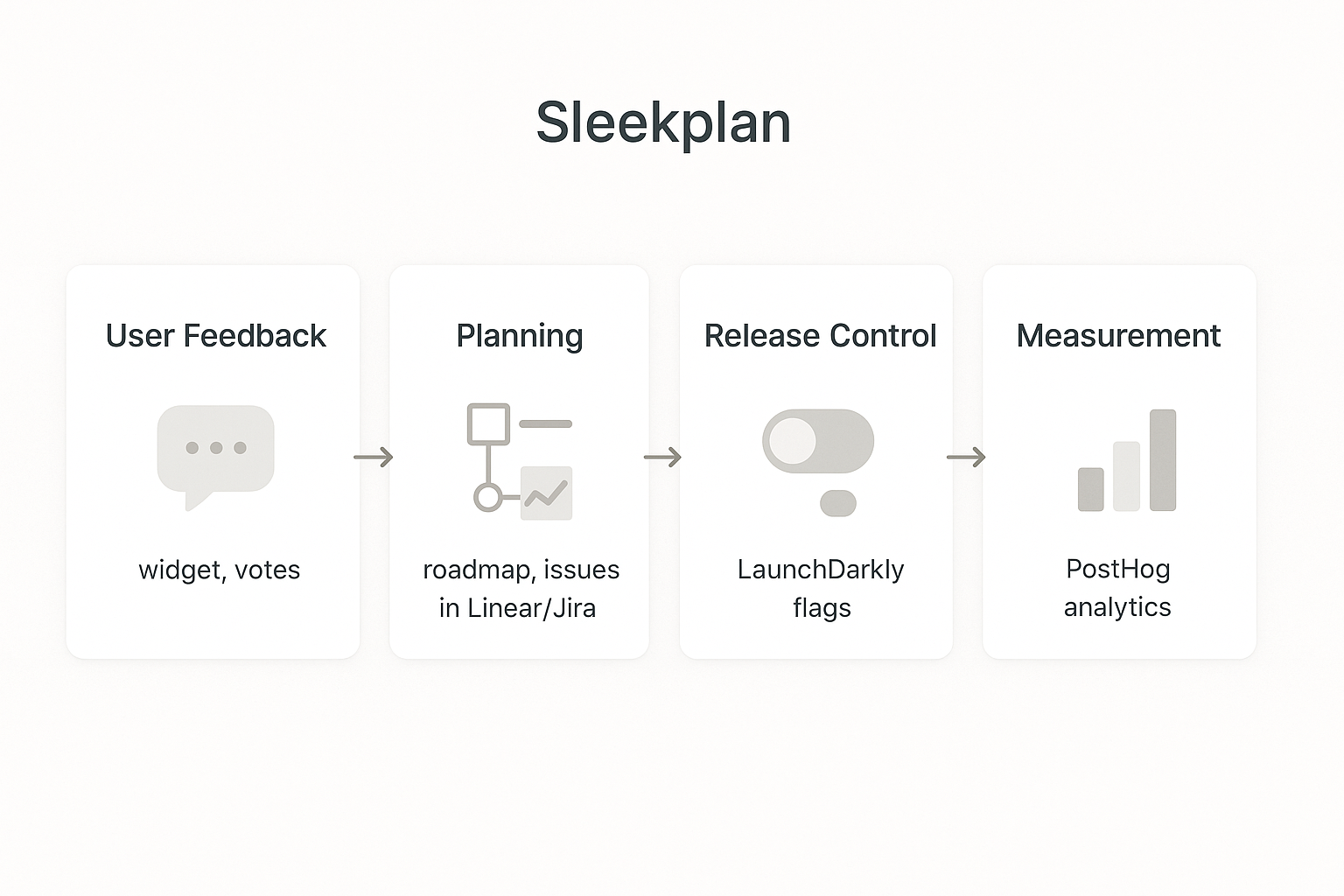
Principle: keep feedback close to the product, then keep promises visible. That is how you build trust.
# Linear MCP Server, conversational issue tracking
Linear is fast. The MCP Server makes it conversational. Ask for blockers, create issues, change priority, or summarize a project without touching the UI.
Practical prompts we use:
- "Create an issue in Growth, title ‘Reduce checkout latency’, label performance, priority high."
- "List high priority bugs not updated in 3 days, assigned to backend."
- "Summarize Q2 epics with risks and proposal for scope cuts."
Result: fewer meeting detours, better hygiene, fewer lost notes.
# MCP Atlassian, Jira + Confluence without the maze
For teams all-in on Atlassian, the MCP server bridges Jira’s work data with Confluence’s knowledge. You can fetch a spec, inspect linked issues, and check sprint health in one thread. Installation paths and scopes are well documented in Atlassian’s remote server guide, and you can cross-check capabilities in Snyk’s roundup: MCP servers for PMs (opens new window).
Use cases we see land fast:
- Retrieve the latest API versioning decision from Confluence, then open Jira tasks to align clients.
- Ask for sprint capacity, velocity trend, and at-risk stories across two teams.
- Generate a release note draft from linked stories, then push to your public changelog.
Principle: one narrative from spec to shipped work, not two disconnected systems.
# PostHog MCP, ask analytics like a human
Data should answer plain questions. With PostHog MCP you can ask them directly, then tie what you learn to experiments and feature flags.
- "Where do power users drop in onboarding, and what does session replay show at that step?"
- "What changed after enabling the new pricing page for 20 percent of traffic?"
- "Which segments would benefit most from faster search, based on query time vs. churn?"
See setup patterns and examples in PostHog’s tutorial: MCP analytics (opens new window).
Principle: measure what users do, not what we hope they do.
# LaunchDarkly MCP, precise rollouts without the scramble
Decouple deploy from release. LaunchDarkly MCP lets a Product Manager define flags, target cohorts, and expand safely.
- "Create flag checkout_new, enable for 5 percent of users, ramp to 25 percent if error rate stays flat for 48 hours."
- "Show current targeting for enterprise tier in EU and APAC."
- "Pause rollout if conversion dips below last week’s baseline."
Get the official overview here: LaunchDarkly MCP getting started (opens new window).
Principle: control exposure, watch signals, move forward with intent.
# Orchestrating the five, an end to tab-chasing
The real win shows up when these MCP Servers work together.
- Start with Sleekplan: find the highest impact user feedback by votes and sentiment.
- Pull relevant specs from Confluence, and the status from Jira or Linear.
- Create or adjust a LaunchDarkly flag for the rollout plan.
- Track adoption and outcomes with PostHog, then close the feedback loop with a public update.
Ask one question and get a narrative: what customers asked for, what we built, how we released it, and what changed in real usage.
# Setup guardrails that scale
Quality beats speed. A few practices we recommend:
- Least privilege: limit MCP scopes and use SSO where possible.
- Naming discipline: standard flag, issue, and label conventions, automated checks where you can.
- Audit trails: log MCP actions that change work items or flags.
- Human judgment: verify high-stakes insights before committing roadmap or budget.
- Start small: pilot with one server and one workflow, expand after 2 to 3 clean wins.
For a broader landscape and roadmap signals, keep Snyk’s guide handy: 7 MCP servers for product managers (opens new window).
# Quick answers
- What is an MCP Server in Product Management? A secure interface that lets an AI assistant read and act in tools like feedback, issues, analytics, and feature flags.
- Which MCP Servers should a Product Manager start with? Sleekplan for user feedback plus either Linear or Jira, then PostHog and LaunchDarkly.
- How does MCP improve user feedback workflows? It centralizes Sleekplan signals, then connects them to issues, rollout rules, and impact metrics.
- Is this safe for enterprise? Yes if you enforce scopes, SSO, audit logs, and approvals for high-impact actions.
# Craft matters
MCP does not replace product sense. It removes the grind so we can spend more time with customers, make cleaner tradeoffs, and ship work we are proud to sign. Tie every release back to user feedback, keep the loop visible, and let the protocol do the heavy lifting.