# A new baseline for product work
AI Agents are no longer sidekicks, they are collaborators. If you are a Product Manager in 2026, your edge comes from delegating multi‑step workflows to agents, not just asking for summaries. The shift is simple to state, hard to fake: move busywork to autonomy, keep judgment human.
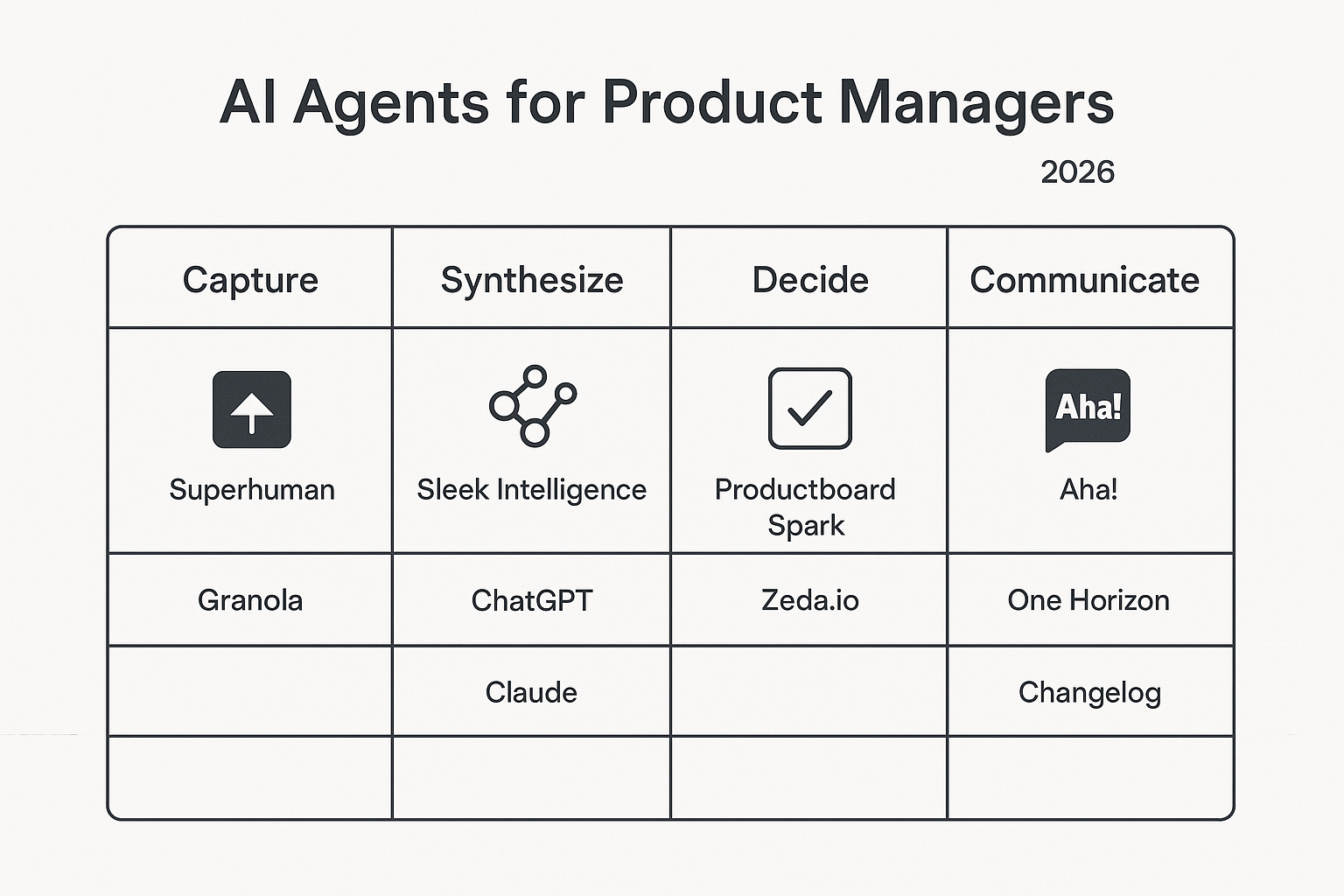
# The shortlist: 10 AI agents product teams actually use
- Sleek Intelligence (Sleekplan)
- Superhuman
- Granola
- ChatGPT
- Claude
- Perplexity
- Productboard Spark
- ChatPRD
- Aha! AI
- One Horizon
Each one solves a different choke point. Together, they form a quiet, continuous system that captures, synthesizes, decides, and communicates.
# 1) Sleek Intelligence: the autonomous product manager that reads your feedback
Sleek Intelligence, powered by Sleek Mate, acts on your entire feedback corpus with persistent context. It integrates via MCP, routes work, deduplicates requests by meaning, and explains its reasoning. You ask, it investigates. Examples we see daily:
- “Cluster the last 200 requests by theme and rank by vote weight.”
- “What are enterprise customers asking for this quarter that we have not shipped?”
- “Draft a customer‑facing note for the OAuth rollout in our voice.”
Why it matters: teams analyze more than 23 percent of feedback only when assisted by agents. With autonomy, you work from the whole signal, not just the loudest voices.
- Explore Sleekplan’s AI: Sleek Intelligence (opens new window)
- Share progress with context: Public Roadmap (opens new window)
- Close the loop cleanly: Changelog features (opens new window)
- See what else ships with it: All features (opens new window)
- Connect your stack: Integrations (opens new window)
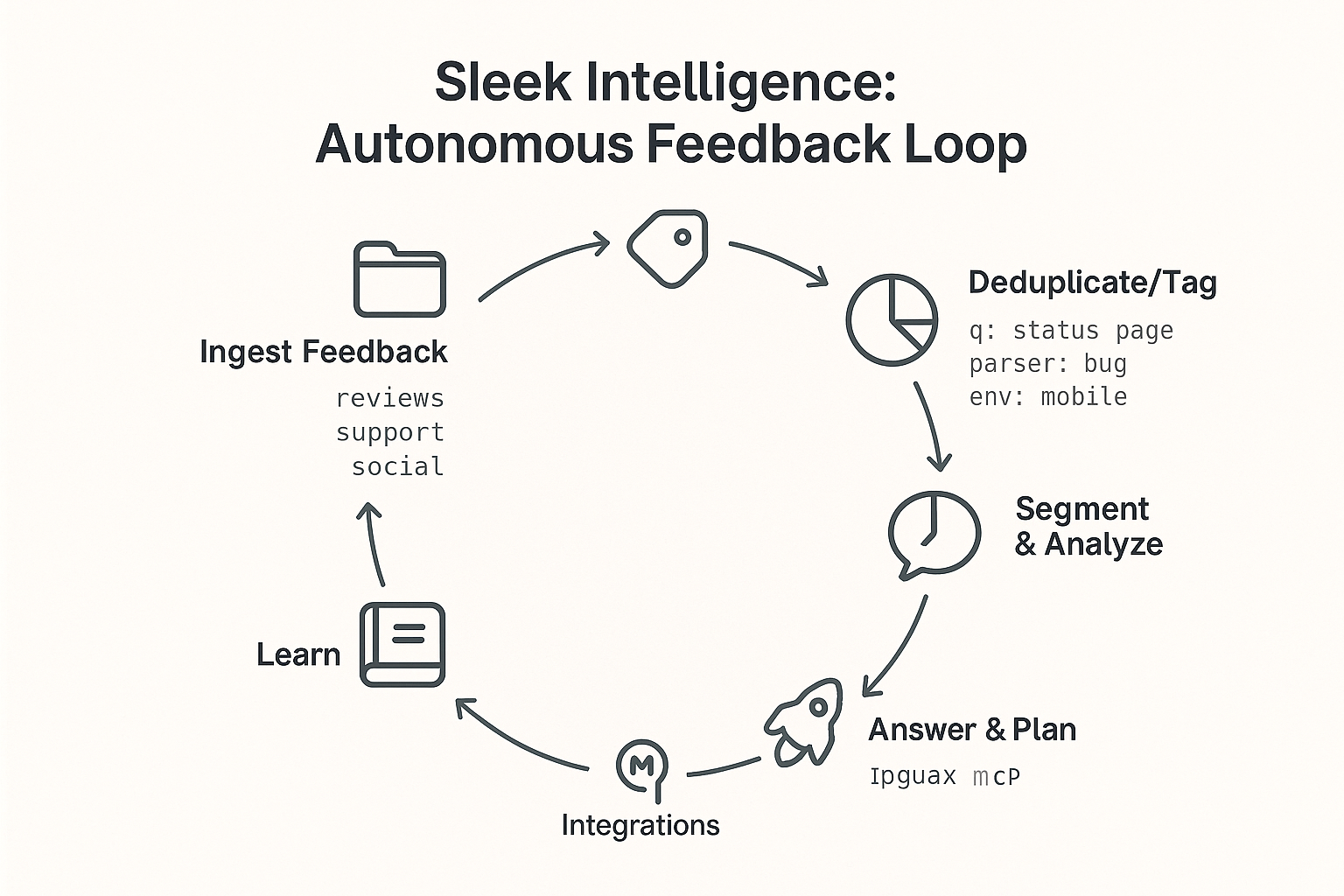
How it works behind the curtain: a multi‑model orchestration layer delegates routine classification to efficient models, then switches to deep reasoning for strategic questions. You can watch the chain of thought as it executes, redirect mid‑task, or take over. Human judgment stays in the loop, deliberately.
# 2) Superhuman: write faster, sound like yourself
Email still moves the needle. Superhuman helps you reach more customers with less editing. It rewrites for clarity without sanding off your voice and keeps the inbox focused on real feedback threads. Follow‑up reminders lift response rates, which means more user signal to act on.
Reference: a useful overview of PM tooling includes Superhuman in the modern stack at Builder.io (opens new window).
# 3) Granola: never miss a research insight again
Granola joins calls, transcribes with high fidelity, and produces structured summaries with quotes, pain points, and highlights. Templates vary by call type, so onboarding interviews and win‑loss reviews are not flattened into the same format. Fewer replays, more signal. Learn more at Granola (opens new window).
# 4) ChatGPT: fast categorization and first‑pass synthesis
When you export a fortnight of Slack threads, survey comments, and support notes, ChatGPT is a strong first sorter. It clusters themes and flags top‑mentioned issues. Use it for speed when you need volume‑based prioritization.
# 5) Claude: deeper reasoning for PRDs and trade‑offs
Claude shines when you ask why, not just what. It drafts PRDs with stronger structure and more strategic depth, and it probes second‑order effects. In independent tests, teams found Claude’s first drafts needed lighter edits than alternatives, especially for leadership‑facing docs. Summary of findings at MindStudio’s analysis (opens new window).
# 6) Perplexity: quick, source‑grounded market research
For competitive scans and market validation, Perplexity aggregates credible sources with citations. Ask how top SaaS products design onboarding flows, then branch to adjacent questions in Research mode. It shortens the path from hunch to externally grounded signal.
# 7) Productboard Spark: continuous pattern detection
Spark reads unstructured feedback across channels, groups it by theme, and updates patterns continuously. Since it sits inside Productboard’s feature hierarchy, insights connect directly to planned work, not just to a dashboard. Deep dive from Productboard’s team is here: Spark AI feedback analysis (opens new window).
# 8) ChatPRD: idea to structured requirements in minutes
Give it a sketch or a rough problem statement, get a PRD with user stories, acceptance criteria, and edge cases. It is a fast way to explore options and iterate before pulling in engineering. For high‑stakes docs, many PMs still favor Claude for nuance, then refine together.
# 9) Aha! AI: strategy and roadmapping in one place
Aha! combines strategy, planning, and releases, then uses AI to propose roadmap structures and draft narrative. It is most valuable when your team wants documents that tie work back to objectives without context‑switching across tools.
# 10) One Horizon: unified view from roadmap to repo
One Horizon aims to collapse roadmap, requirements, and execution into one model. Natural‑language queries like “What slipped last week and why?” return answers tied to commits, PRs, and issues. When visibility beats ceremony, this design pays for itself.
# Quick picks by job to be done
- Capture more, with less effort: Superhuman, Granola
- Synthesize and reason: Sleek Intelligence, Claude, ChatGPT
- Decide what to build: Productboard Spark, Sleek Intelligence
- Communicate with clarity: Aha!, Sleekplan Changelog (opens new window)
# How Sleek Intelligence changes the feedback loop
What makes Sleek Intelligence different is not just analysis, it is autonomous execution:
- Triage at scale: tag, categorize, and route hundreds of items without manual review
- Smart deduplication: merge near‑identical requests by meaning, consolidate votes
- Segment‑aware answers: evidence pulled by cohort, plan, region, or spend
- Human‑ready outputs: PRDs, changelog entries, and stakeholder notes in your voice
We built it to respect ownership. You see the source, reasoning, and trade‑offs before acting.
# Also worth watching
These are strong complements if you are building a broader agent stack:
- Zeda.io (opens new window) for auto‑tagging and trend detection across Slack, tickets, and interviews
- Jira Rovo AI for natural‑language queries on project status
- Mixpanel Spark for conversational analytics
- Amplitude predictions for churn and conversion likelihood
- Notion AI for workspace‑aware summaries and connected context
- GravityDoc for turning UI screenshots into structured docs
- Kraftful for feedback analysis with hallucination controls
# FAQs
- What is an AI agent for product management? An AI agent observes context, reasons about goals, and takes actions across tools to complete multi‑step PM workflows, not just answer prompts.
- Where should a Product Manager start? Start where the pain is measurable. If feedback analysis lags, deploy Sleek Intelligence (opens new window). If research notes pile up, use Granola. If PRDs stall, draft in Claude or ChatPRD.
- How does Sleekplan fit my stack? Through MCP and native integrations. See available Integrations (opens new window) and pair with your roadmap and comms via Public Roadmap (opens new window) and Changelog (opens new window).
- How much time can AI Agents save a PM? Teams report cutting repetitive work by half and reclaiming hours per sprint. Independent overviews point to similar gains at Builder.io (opens new window).
# Principles for adopting AI agents with taste
- Quality over speed: only ship outputs you would sign with your name
- Keep humans in control: transparency, interruption, and override are non‑negotiable
- Connect the loop end to end: capture, synthesize, decide, communicate
- Measure impact: time saved, decision quality, and downstream outcomes
# A closing note on craft
The best Product Manager uses AI Agents to hear more customers, think with more context, and communicate with more precision. Agents do the heavy lifting. You keep the taste, the trade‑offs, and the trust.