The product operating model is the quiet discipline behind companies that ship the right things consistently. It aligns teams, decisions, and funding around customer outcomes, not feature checklists. If you are moving from projects to products, this model gives you a stable spine that connects strategy to delivery.
What is a product operating model?
A product operating model is a company’s system for turning strategy into customer value at a steady, sustainable pace. It prioritizes outcomes over outputs, pairs goals with empowered teams, and blends culture, process, and structure into one clear way of working. See definitions from ProductPlan and SVPG for deeper framing:
- ProductPlan’s glossary on the operating model highlights the bridge from strategy to execution and the shift to customer centricity: https://www.productplan.com/glossary/product-operating-model/
- SVPG explains why outcomes beat feature lists and how product culture anchors everything: https://www.svpg.com/the-product-operating-model-an-introduction/
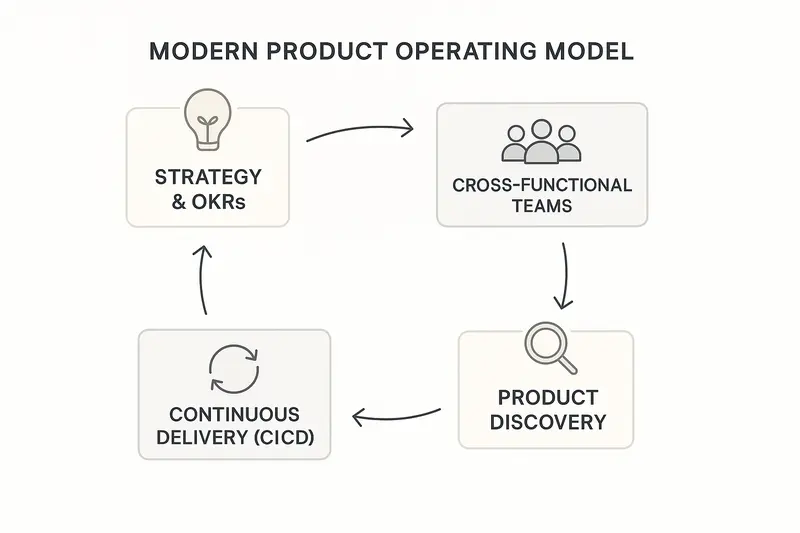
Quick answer for your leadership doc: a product operating model is how we consistently create technology-powered solutions that customers adopt, that the business can support, and that move our key metrics.
From projects to products
Projects run on the Iron Triangle, a fixed scope bound by time and cost. It works when markets change slowly. Today they do not. Requirements written a year ago age quickly, so teams ship on time and still miss the mark. See comparisons and context from Blueprint and Product School:
- Blueprint’s project vs product breakdown: https://www.blueprintsys.com/blog/7-key-differences-between-project-product-management
- Product School’s primer on modern operating models: https://productschool.com/blog/product-strategy/product-operating-model
The product shift keeps teams durable, accountable to outcomes, and free to adapt. The work does not end at a release; it compounds.
The three core components
1) Culture: how people behave
Strong product cultures choose principles over process and outcomes over output. Four simple rules, adapted from SVPG:
- Trust over control: empower teams close to the problem.
- Principles over process: light guardrails, clear intent.
- Innovation over predictability: learn through safe experiments.
- Learning over failure: run tests, keep what works.
Thoughtworks expands on codifying these beliefs into a product manifesto and performance system: https://www.thoughtworks.com/en-us/insights/articles/how-to-create-a-product-operating-model-to-support-product-organization-transformation
2) Flow: how work moves
Strategy must flow into quarterly objectives, then into team bets. Use OKRs to connect intent to choices, and set governance for risk, compliance, and decision rights. Planview’s guide outlines timelines, funding shifts, and OKR alignment:
- Planview on transformation and metrics: https://www.planview.com/resources/guide/master-the-product-operating-model-core-principles-for-leaders/product-operating-model-transformation/
3) Structure: how people are organized
Cross-functional, durable teams own problems end to end. Clear roles remove friction.
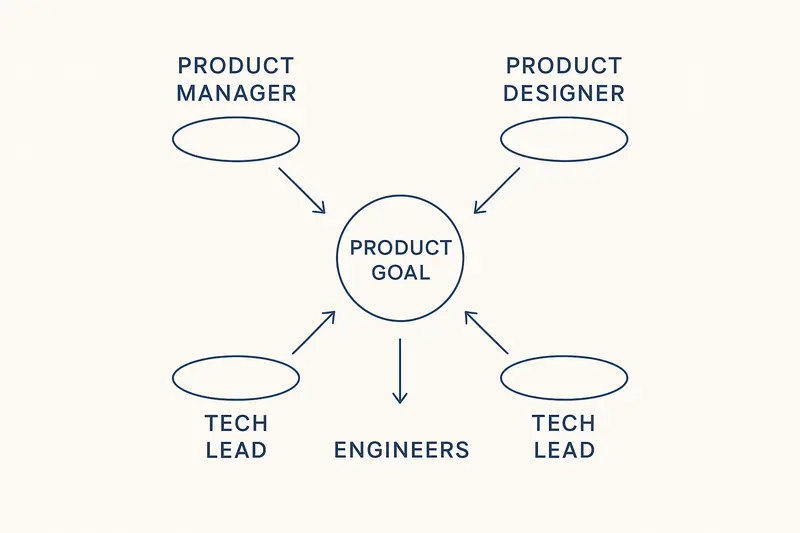
Typical pattern:
- Product manager: accountable for value and viability.
- Product designer: accountable for usability and experience.
- Tech lead: accountable for feasibility and quality.
- Engineers: accountable for implementation and reliability.
The three dimensions and five concepts
SVPG’s framing is practical and sharp.
Three dimensions of daily work:
- How we build: small, frequent releases with CI/CD, ideally weekly or even continuous.
- How we solve: teams get problems, not feature lists, and validate value, usability, feasibility, and viability.
- What we choose: product leaders pick problems to solve using vision, data, customer insight, and technology leverage.
Five concepts working together:
- Product culture: shared beliefs and decision habits.
- Product strategy: quarterly bets that ladder to annual goals.
- Product teams: empowered, outcome-driven, tightly aligned.
- Product discovery: rapid experiments to de-risk ideas.
- Product delivery: clean code, strong monitoring, safe releases.
Variations that work in the real world
Different contexts call for different tactics.
- Chess style, like Spotify: heavy alignment and sequencing, then smooth execution. Read a field view: https://productatheart.com/blog/how-we-work-product-operating-models-in-practice-product-at-heart-2024
- Poker style, like Wallapop: clear intent, flexible bets, quick adaptations as conditions change.
- Startup vs enterprise: startups stay lightweight, enterprises add portfolio management and platform governance.
The principle holds: adapt the playbook to your constraints, keep outcomes central.
Implementing the product operating model
Readiness check
Two tests from Product Talk: does the CEO doubt the current model, and do they feel the pain to change it. Without both, momentum fades: https://www.producttalk.org/organizational-readiness/
Phased path and realistic timelines
- Months 0 to 2: assess current state, define the target model, set success criteria.
- Months 2 to 4: design teams, value streams, governance, and product funding.
- Months 4 to 8: pilot two or three products, coach teams, iterate.
- Months 8 to 18: scale in waves, retrain HR and finance, evolve tooling.
- Beyond 18 months: embed habits, improve continuously.
Small firms often need 18 to 24 months. Mid-size, 24 to 36. Large enterprises, 36 to 48. Compressing usually leads to half-finished change.
Measurement that reinforces outcomes
Track both leading and lagging signals:
- Leading: NPS, qualitative feedback volume, decision latency, weekly release cadence.
- Outcomes: adoption rates, feature usage, activation time, retention and churn.
- Business: revenue growth by product, time to value, ROI of quarterly bets.
- Flow: lead time, cycle time, work in progress, change failure rate.
Planview’s metric guide is a solid reference: https://www.planview.com/resources/guide/master-the-product-operating-model-core-principles-for-leaders/product-operating-model-kpis-and-metrics-to-measure-success/
Common pitfalls and fixes
McKinsey calls out patterns that stall transformations, all fixable with crisp intent and cadence: https://www.mckinsey.com.br/capabilities/people-and-organizational-performance/our-insights/how-to-get-your-operating-model-transformation-back-on-track
- Vague goals: tie model changes to quantified targets, for example cut lead time by 30 percent.
- Partial change: align culture, structure, governance, and funding together.
- Culture ignored: train new behaviors, update performance systems.
- Annual planning grip: move to quarterly reallocation tied to outcomes.
- Slow top-team alignment: decide once, communicate often, then execute fast.
- Backslide risk: set rituals that keep the model alive, for example quarterly product reviews.
Where customer feedback fits in the model
Continuous feedback closes the loop between strategy and delivery. We have seen teams win when they:
- Capture ideas, votes, and sentiment in one place.
- Tie feedback to OKRs and roadmap bets.
- Ship in small batches, publish changelogs, and follow up with the customers who asked.
- Track impact, for example reduce onboarding drop-off by 15 percent or fix high-priority bugs within 7 days.
If you want AI help to summarize themes, spot churn risk, and cluster pain points by segment, try Sleekplan Intelligence: https://sleekplan.com/intelligence/
FAQ: fast answers for busy leaders
- What is a product operating model? The system that aligns culture, structure, funding, and delivery so teams ship measurable outcomes, not just features.
- How is it different from project models? Products keep durable teams focused on ongoing customer value, projects end when scope is delivered.
- How long does it take? Expect 18 to 48 months depending on size. Pilot early, scale in waves.
- Do we need modern tech first? Upgrade in parallel. You need CI/CD, observability, and modular architecture to feel the full benefits.
Craft, not theater
Good operating models are quiet. Clear goals, small releases, honest metrics, and respectful feedback loops. No ceremony for its own sake. The work looks simple from the outside. Inside, it is craft and steady judgment, applied every week.