Why this library now
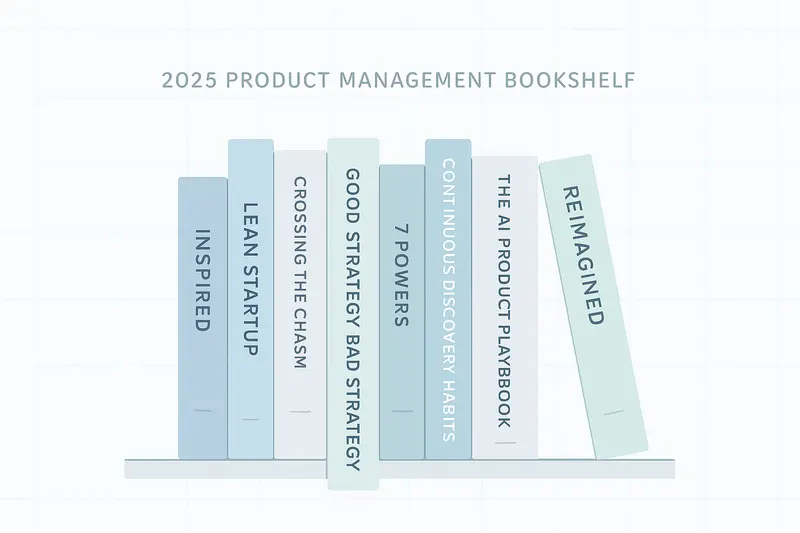
Product management books for 2025 are not nice to have, they are your operating system. AI reshaped discovery, strategy, and execution. This curated product management library focuses on quality, not volume, so you build customer centric products with fewer wrong turns. For broader context, the overview from Mind the Product is a solid companion resource: https://www.mindtheproduct.com/top-product-management-resources-for-summer-2025/
Foundational frameworks that still hold
Strong products start with principles, not tools.
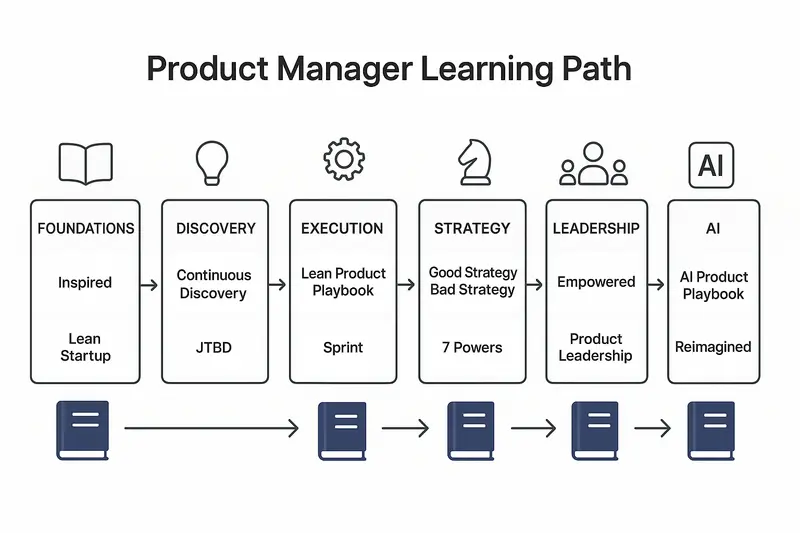
- Inspired, Marty Cagan. Problem before solution, outcomes over outputs, empowered teams. Check your org against this standard.
- The Lean Startup, Eric Ries. Build measure learn, but with a higher minimum today. Parallel experiments beat sequential bets.
- Crossing the Chasm, Geoffrey Moore. Pick a beachhead, ship a whole product, earn word of mouth. The practical breakdown from a16z is concise: https://a16z.com/crossing-the-chasm-in-practice/
Takeaway: foundations keep you honest when trends get loud.
AI product management, from theory to practice
You do not need a PhD to ship sensible AI features. You need judgment, data literacy, and patterns.
- The AI Product Playbook. Clear workflows for scoping, evaluating, and governing AI. Ethics, risk, and collaboration sit at the center. See the publisher page for details: https://www.wiley.com/en-us/The+AI+Product+Playbook:+Strategies,+Skills,+and+Frameworks+for+the+AI-Driven+Product+Manager-p-00440656
- Reimagined: Building Products with Generative AI. 150+ examples, case studies, and playbooks for MVPs, PLG, and trust. Skimmable and practical: https://www.scribd.com/document/793777885/reimagined-building-products-with-generative-ai-9798989966905
Principle: stay close to real jobs and real constraints. Ship AI where it meaningfully reduces friction or unlocks new value, not because a slide says “AI powered.”
Customer discovery and JTBD that actually changes roadmaps
Research is only useful when it changes what you build.
- Continuous Discovery Habits, Teresa Torres. Weekly interviews, opportunity trees, small bets, transparent decision logs.
- Jobs to Be Done. Functional, social, and emotional jobs explain real choices. The Christensen Institute’s primer is a crisp start: https://www.christenseninstitute.org/theory/jobs-to-be-done/
Put both together: collect specific stories, map jobs, then decide the smallest meaningful change that improves the job. For us, consistent customer feedback is the backbone. If you want an AI assist that clusters themes and reduces analysis time, see Sleekplan Intelligence: https://sleekplan.com/intelligence/
Strategy that compounds instead of slides that sparkle
Pretty roadmaps are easy. Durable advantage is not.
- Good Strategy Bad Strategy, Richard Rumelt. Diagnose the real constraint, pick a guiding policy, align coherent actions. No fluff.
- 7 Powers, Hamilton Helmer. Know where your moat could come from: scale, network effects, switching costs, brand, cornered resources, process power, counter positioning.
Rule of thumb: commit to one or two powers, articulate the tradeoffs, then decline work that does not advance them.
Execution playbooks that respect craft
Shipping is a skill. So is saying no.
- The Lean Product Playbook, Dan Olsen. Product Market Fit Pyramid, interview scripts, proto testing, measurable iterations.
- Sprint, Jake Knapp. Five focused days, one Decider, a tested prototype by Friday.
Small example: we schedule usability fixes within 7 days of discovery, then reserve capacity for one experiment per sprint. Quality climbs, risk drops.
Leadership and influence without theater
Teams do their best work when leaders coach, not dictate.
- Empowered, Marty Cagan with Chris Jones. Team topology, coaching, vision craft, and executive partnership. Structure creates autonomy.
- Product Leadership, Banfield, Eriksson, Walkingshaw. Patterns across company stages, how to grow people, and how to tie vision to roadmaps.
Signal to your team: clear goals, crisp decisions, visible learning. No half finished work shipped.
Reading paths by career stage
Choose one path and commit. Depth beats speed.
- Beginners
- Inspired, The Lean Startup, The Lean Product Playbook
- Continuous Discovery Habits, The Design of Everyday Things
- Intermediate PMs
- Escaping the Build Trap, Jobs to Be Done
- Made to Stick, Listen Like You Mean It, Good Strategy Bad Strategy
- Product leaders
- Empowered, 7 Powers, Product Leadership
- The AI Product Playbook or Reimagined, depending on your stack
Quick answers
- What are the best product management books for beginners in 2025?
- Start with Inspired, The Lean Startup, and The Lean Product Playbook. Add Continuous Discovery Habits to build weekly research habits.
- Which AI product management book should I read first?
- If you want structured frameworks, pick The AI Product Playbook. If you want hands on examples, pick Reimagined.
- How many books should I read per quarter?
- One or two. Apply each book to a live problem. Document what changed.
- How do I turn reading into better roadmaps?
- Tie every initiative to a customer job, a measurable outcome, and one strategic power. Review monthly.
Bring it into your practice
Keep this library close, but keep your customers closer. Pair weekly discovery with disciplined strategy, then let execution habits do the slow, compounding work. When feedback volume grows, use tools that respect signal over noise and help you act quickly without cutting corners.
For a practical next step, instrument a feedback loop that flags themes automatically and links insights to roadmap decisions. If you need an assist, try Sleekplan’s AI insights to turn raw feedback into clear opportunities: https://sleekplan.com/intelligence/