Start with the real problem
When teams skip a product vision framework, roadmaps drift, priorities fight, and work feels busy but aimless. A clear product vision framework sets a north star, aligns strategy to customer needs, and turns intent into measurable outcomes.
What is a product vision framework?
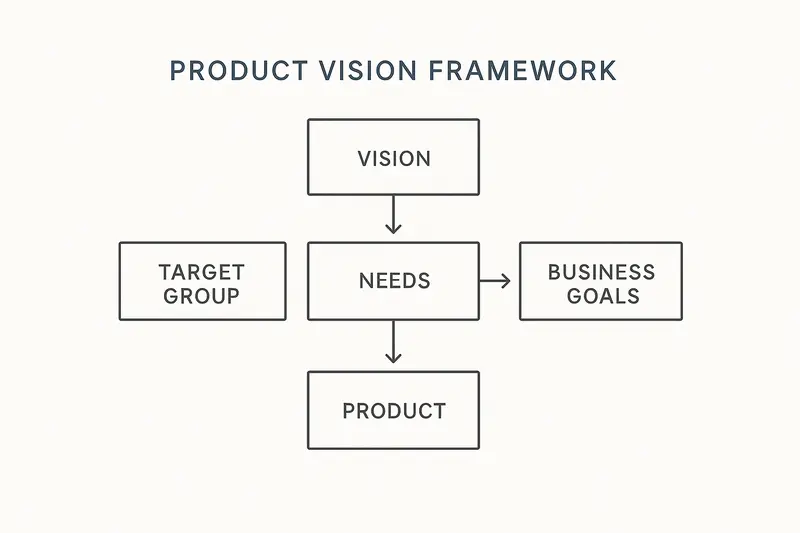
A compact system that states why your product exists and how it creates value, then ties that purpose to strategy and execution. Core parts:
- Vision statement: the future you are building toward
- Target group: who you serve with specificity
- Needs: the human problems to solve
- Product: the differentiating capabilities
- Business goals: the outcomes for the company
For structure, many teams use Roman Pichler’s Product Vision Board, which connects these elements in one view. See the framework on Roman Pichler’s site for format and tips: Product Vision Board.
Vision vs strategy vs roadmap
These are not synonyms. They work at different altitudes.
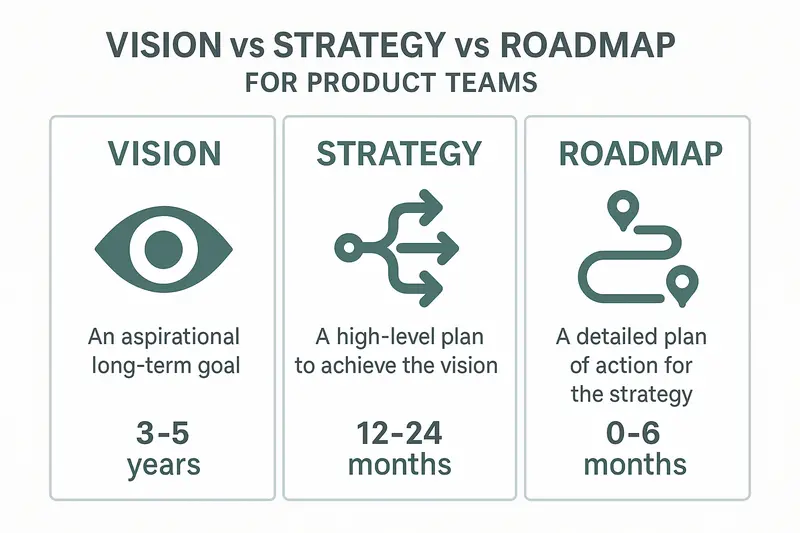
- Vision: the destination and why it matters, 3 to 5 years
- Strategy: the path to get there, markets and choices, 12 to 24 months
- Roadmap: what ships next and when, 0 to 6 months
For a crisp comparison and pitfalls to avoid, see Product School’s guide on vision vs strategy and ProductPlan’s advice on aligning vision.
The components that matter
- Vision statement: short, memorable, emotionally real. Example: Slack, make work life simpler, more pleasant, more productive.
- Target group: vivid and narrow. Example: finance managers at mid-market SaaS firms, not “business users.”
- Needs: describe outcomes, not features. Example: “close the books without weekend work,” not “a reporting dashboard.”
- Product: 3 to 5 differentiators that solve the needs. No feature soup.
- Business goals: revenue, retention, market position, brand commitments.
Takeaway: clarity beats breadth. Being specific unlocks better decisions.
How to create your product vision, step by step
- Study the market: trends, threats, underserved segments, switching costs. Pull from analyst notes and direct interviews.
- Build personas and empathy maps: behaviors, decisions, pains, desired outcomes. Do this cross-functionally to avoid siloed myths.
- Ideate beyond constraints: future-headline and “walk into the future” exercises help teams think in outcomes, not features.
- Prioritize: score ideas against strategic fit, feasibility, market size, differentiation, and team conviction.
- Draft and refine: use a template, then wordsmith until it sings.
- For [target], who [need], [product] is a [category] that [benefit]. Unlike [alternatives], it [differentiation].
- Socialize: share the story multiple times, in multiple formats, until every team can recite it and explain trade-offs it implies.
Helpful resources: facilitation techniques from MURAL and workshop formats by Adam Fard are practical starting points, see ProductPlan on aligning vision.
Turn vision into decisions
Use the vision as a filter. If a request does not move you toward the vision, it is a no, or a not now. This discipline prevents scope creep and keeps the product coherent. High-performing teams consistently do this, even when the request is tempting.
Implementation best practices
- Keep the vision stable, evolve the strategy. Markets change, the north star should not swing every quarter.
- Translate to OKRs and KPIs. Objectives guide the quarter, metrics prove movement. A clear primer: Atlassian on OKRs.
- Make trade-offs explicit. Write 3 things you will not do this quarter because they do not advance the vision.
- Align cross-functionally. Engineering, design, marketing, sales, and success should all map their priorities to the same vision.
- Review often. Quarterly checks maintain relevance without churn.
Common mistakes to avoid
- Vague slogans: “be a leader in innovation.” Say what changes for whom and how.
- Vision tied to a tactic: “be the top mobile app for X.” Keep it above channels and tech.
- No emotional pull: facts alone rarely mobilize teams. Write for head and heart.
- Constant pivots: if the vision changes monthly, it is a strategy or roadmap problem in disguise.
- Misaligned with company mission: your vision should be a clear expression of the company’s purpose.
From vision to metrics that matter
- North Star Metric: the best single indicator that customers get sustained value. Examples:
- Collaboration tool: weekly active collaboration sessions per user
- Marketplace: successful transactions per buyer
- Analytics platform: decision events triggered from insights per account
- Supporting KPIs: adoption, retention, time to value, expansion, quality.
- OKR ladder: company objectives cascade into product and team OKRs. Tie every key result to an outcome, not a feature count.
For a pragmatic lens on metric stacks, read the metrics “sandwich” model by John Cutler.
Continuous discovery keeps the vision honest
Meet customers weekly or bi-weekly. Validate problems, test narratives, watch behavior. Bring engineers and designers into sessions to build shared judgment. Keep a living repository of insights and decisions linked to the vision.
If you need help turning raw feedback into clear themes, our team uses Sleekplan to centralize requests, auto-categorize with AI, and tie insights to roadmap outcomes. See how this works in practice: Sleekplan Intelligence.
A quick template you can copy
- Vision: For [target group] who need [primary outcome], we will [transformative promise] so they can [measurable impact].
- Three differentiators: [capability 1], [capability 2], [capability 3].
- Business goals: [goal 1], [goal 2], [goal 3].
- North Star Metric: [single metric] with leading indicators [list].
Fast answers
- What makes a great product vision? Short, specific, customer-outcome focused, emotionally resonant.
- How long should it be? One line or a tight paragraph that teams can recall without notes.
- Who owns it? Product leadership crafts it with cross-functional partners, the whole org owns execution.
- How often to update? Review quarterly, revise only when the purpose truly shifts.
The quiet advantage
A precise vision reduces noise. It sharpens decisions, aligns teams, and steadies execution when markets wobble. Craft it with care, then use it daily. The detail is the strategy.