Why lifecycle thinking matters now
Markets move fast, but craft still wins. Product lifecycle management sits at the center of that craft. Treat it as a discipline, not a diagram. In practice, product lifecycle management threads strategy, customer feedback, and cross‑functional work through four shifting environments.
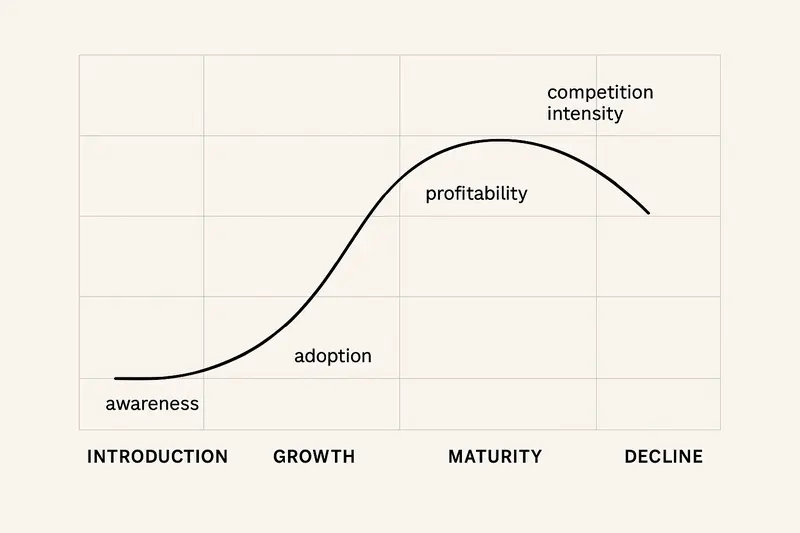
Product lifecycle management, in plain terms
Real products do not follow a neat sequence. They loop, stall, and leap. The job is to notice the turn early, then act with intent. PLM integrates people, process, and data so those calls are timely. For a solid overview, see the lifecycle framing from ICAgile and the PLM guide by Atlassian.
- Principle: Quality over speed. Going faster in the wrong direction burns trust.
- Principle: Details compound. Small choices in pricing, onboarding, and handoffs shift outcomes.
Stage 1: Introduction
You are buying learning. Profit comes later.
- Market validation first: Ship a tight slice, talk to customers weekly, and prove willingness to pay. Treat assumptions as hypotheses until data and judgment agree.
- Pricing choices: Skim when novelty is scarce and budgets are deep. Penetrate when network effects or cost leadership matter.
- Educate, do not just promote: Demos, trials, and crisp explainers outperform glossy ads. Make the first run frictionless.
- Manage risk: Fund the pre‑profit period. Kill weak bets early. Timebox proof points such as “20 qualified design partner accounts in 60 days.”
Signals you are ready for growth: repeatable acquisition channels, onboarding that gets users to first value in minutes, and early NPS above neutral with clear promoters.
Stage 2: Growth
Demand compounds, competitors arrive, and cracks in your infrastructure show.
- Scale the system: Uptime, response times, and support SLAs are now differentiators.
- Acquire and retain: Marketing shifts from category awareness to product preference. Customer success turns expansion into a habit.
- Evolve the product: Ship improvements that reflect actual usage, not internal wish lists. Close the obvious gaps faster than rivals.
- Expand the market: New segments, geos, and channels reduce concentration risk.
A clear map of where to double down beats a crowded roadmap. We review usage heatmaps and the top five churn reasons before any big bet.
Stage 3: Maturity
Growth slows. Profit peaks. Competition is relentless.
- Defend margin through efficiency: Tighten cost to serve. Simplify SKUs. Automate the repetitive.
- Segment and position: Tailor offers to premium, core, and value tiers. Protect pricing power with real differentiation.
- Refresh meaningfully: Variant strategies work when they solve real jobs, not when they add noise. Ship fewer, better upgrades.
- Earn loyalty: Retention programs, thoughtful onboarding refresh, and proactive success reviews keep the base secure.
Extending maturity is about focus. One thoughtful redesign or new use case can add years.
Stage 4: Decline
Curves fall. Choices narrow. You can harvest, revitalize, or exit.
- Harvest: Reduce investment, maintain support quality, and serve the loyal base with clear timelines.
- Revitalize: Reposition, redesign, or target new segments where the job still exists.
- Divest: Sell or sunset to free capital for the next wave. End with dignity and data portability.
Decline is not failure. It is a stewardship phase. Treat customers fairly and your brand survives to launch again.
Customer feedback across the lifecycle
Feedback is the throughline. We treat it as an operating system, not a mailbox.
- Early: Concept tests, prototypes, and design partners keep you honest.
- Growth: In‑app prompts and structured interviews steer prioritization.
- Maturity: Scaled surveys plus cohort analysis reveal where value erodes.
- Decline: Requests cluster around stability, support, and migration paths.
If you want AI‑assisted signal detection, see how we approach feedback analysis with Sleekplan Intelligence. Tools help, judgment decides.
Cross‑functional alignment that actually works
Strong PLM is a team sport. We rely on tight loops between product, engineering, marketing, sales, and success. Product reviews with a crisp agenda, shared KPIs, and visible tradeoffs keep the story coherent. For practical structures and roles, the primers from Atlassian and the lifecycle lens from ProductPlan are useful references.
- Clarity beats consensus: Define who decides, who inputs, and how decisions are communicated.
- Show the work: Roadmap notes, rationale, and post‑launch readouts build trust.
Metrics that matter by stage
Measure what the stage demands, not everything you can.
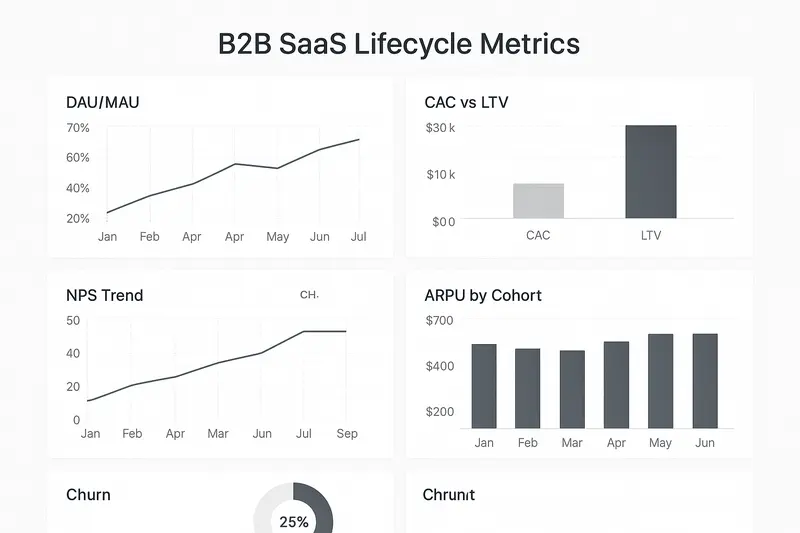
- Development and launch: On‑time delivery, defect escape rate, activation rate, DAU or MAU.
- Early growth: CAC alongside LTV, time to first value, feature adoption depth.
- Maturity: Net revenue retention, gross margin, ARPU by cohort, churn reasons.
- Decline: Run‑rate margin, support costs per account, migration completion rate.
For deeper metric definitions and benchmarks, this overview from Databox is a helpful starting point.
Practical plays we return to
- Guardrails: Define stage‑specific OKRs such as “Bugfixes within 7 days” in growth, or “Reduce cost to serve by 12 percent” in maturity.
- Narrative first, numbers second: Start reviews with the customer story, then the dashboard. Numbers are lenses.
- Kill switches: Pre‑commit criteria to stop a feature or campaign. It saves time and morale.
- Fewer bets, higher bar: Ship less, finish more. No half‑done features.
Quick answers
- What is product lifecycle management? A cross‑functional practice that steers a product through introduction, growth, maturity, and decline with stage‑specific strategy.
- Which PLM strategies drive early traction? Tight market validation, clear onboarding, and pricing that fits the job to be done.
- How do I choose harvest vs revitalize? Compare remaining LTV, cost to serve, and the credible path to new demand. If you cannot win a new job, harvest.
- Which metrics prove product‑market fit? Strong activation, frequent usage, expanding cohorts, and NPS that trends up with fewer detractors.
Final take
Great PLM is quiet, steady work. Notice the stage, align the team, and let customer feedback guide the next decision. If you keep the craft high and the feedback tight, the curve stays kind.
Further reading to deepen your approach:
- The four stages of PLM by ICAgile
- Product lifecycle responsibilities via ProductPlan