Why feature voting still matters
Feature Voting is no longer a vanity poll. In 2026, the best product teams treat a voting Board as part of a disciplined System, not a popularity contest. The right Software and Tool stack turns raw signals into clear decisions across your App.
- Weighted input beats raw counts.
- Segmentation shows who wants what and why.
- Closed-loop communication reduces churn and builds trust.
What modern feature voting looks like
At its core, customers submit ideas and vote. The difference now is identity, value, and context. Votes are tied to accounts, segments, and revenue, then routed into a repeatable workflow. Teams combine voting data with product judgment, not replace it.
- Simple upvotes for clarity, or up and down for sentiment.
- Weighted voting for economic impact, like ARR-based multipliers.
- Status workflows for Under Review, Planned, In Progress, Released.
The business case that holds up in 2026
Feature voting Software aligns roadmaps with real demand, not internal debate.
- Reduce waste: ship what users ask for, skip the 64 percent of features that sit unused.
- Faster prioritization: replace opinion standoffs with quantified signals.
- Loyalty impact: public Boards and visible progress lift NPS and reduce silent churn. Practical steps in Prodcamp’s breakdown.
Takeaway: engagement is not a side effect, it is a retention strategy.
The architecture of a modern System
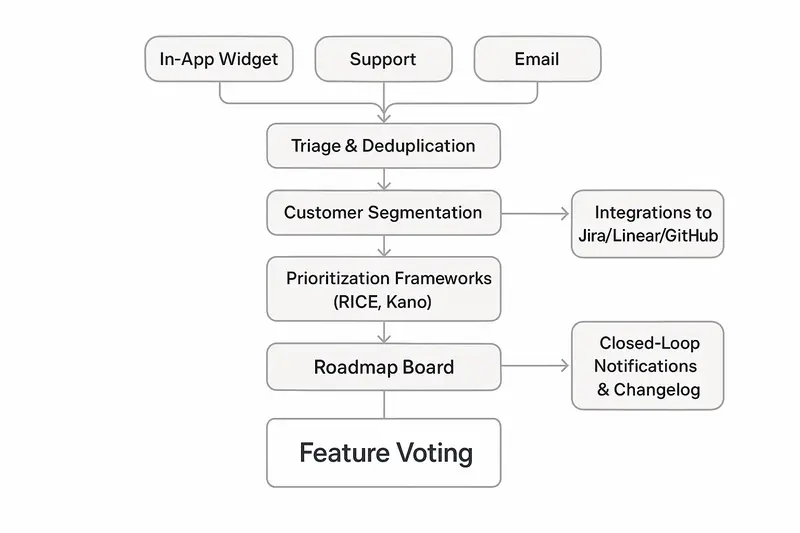
A robust feature voting System behaves like a pipeline from insight to shipment.
- Collection, capture from multiple inputs
- In-app widget, email, support desk, public portal.
- Auto merge suggestions to avoid duplicate clutter.
- Triage, problem before solution
- Normalize titles, merge overlaps, clarify scope.
- Ask for problems, not just solutions.
- Segmentation, context that changes everything
- Plan tier, company size, ARR, industry, region, role.
- Spot patterns like enterprise demand versus SMB noise.
- Weighting, influence with intent
- Apply ARR or tier multipliers with transparent rules.
- Keep low-tier voices visible, just not decisive.
- Roadmap sync, work meets workflow
- Link requests to Jira, Linear, or GitHub issues.
- Auto update statuses and notify voters when work moves.
- Communication, close the loop
- Notify on In Progress, Shipped, or Not Planned.
- Publish a changelog and link back to the original request.
Visualizing weighted votes on a Board
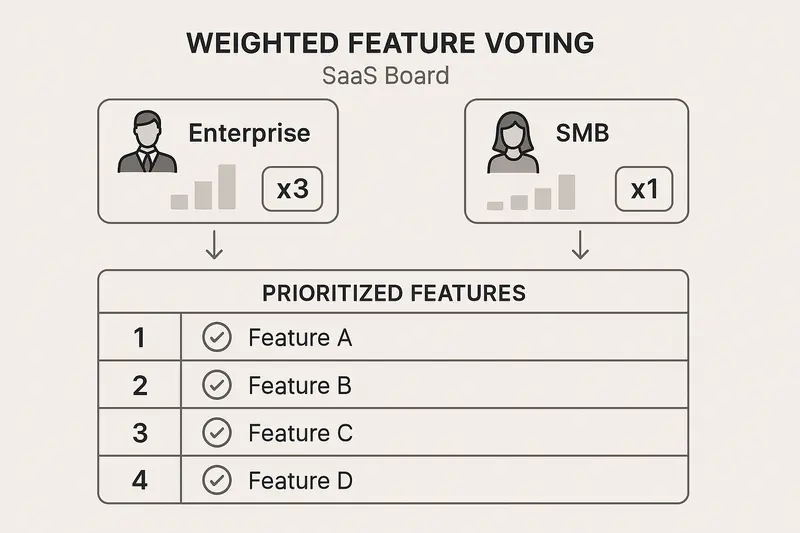
- Enterprise votes x4, Mid-market x2, Standard x1.
- A 40-vote SMB request may rank below a 12-vote Enterprise need when revenue impact is clear.
- Keep the policy public to maintain trust.
Implementation playbook, from setup to steady state
- Access and auth: use SSO to cut friction. You will get more signal with less noise.
- Voting rules: decide on anonymous versus authenticated. If you weight by revenue, you need identity.
- Segmentation design: mirror your GTM segments. Start with plan tier, ARR, industry, role.
- Cadence: weekly triage for new ideas, monthly prioritization forum across PM, design, and engineering.
- Tool integration: wire your Board to issue tracking so status is always current.
Avoid the usual traps
- Problem vs solution confusion, customers ask for CSV export, the real need is shareable data. Interrogate the why. See the critique by Jason Evanish.
- Vote dilution, users upvote tangents. Merge duplicates, cap votes per user, tighten categories.
- Recency bias, fresh posts collect momentum. Rotate board sorting, highlight canonical requests.
- Power user bias, a few experts drown out the base. Use segmentation and weighting to balance.
- Strategy drift, totals are inputs, not orders. Keep product vision in the room.
Frameworks that turn signals into choices
Voting does not replace prioritization, it feeds it.
- RICE, blend voting Reach with Impact, Confidence, and Effort. Quick primer in this short video.
- Kano, spot Basics versus Performance versus Delighters. Broad, cross segment votes often point to Basics that prevent churn.
- MoSCoW, Must, Should, Could, Will not. Use votes to fill buckets, then apply strategy.
- Value versus Effort, map revenue-weighted value on one axis and build cost on the other.
Rule of thumb: when RICE, Kano, and your weighted Board agree, ship it.
Close the feedback loop like you mean it
Silence kills engagement. Automate updates to everyone who voted or commented. Explain decisions, even when the answer is Not Planned.
What to include in updates
- Status change, where the work sits now.
- Why now, how prioritization was decided.
- What shipped, scope, docs, and a link to your changelog.
Segmentation, the real leverage
The same vote count can tell opposite stories based on who voted.
- By plan, Enterprise-heavy votes often indicate expansion revenue.
- By industry, regulated verticals signal compliance features early.
- By behavior, power users push advanced controls, casual users need defaults.
Measuring ROI of your feature voting Tool
Treat your Board like any other product investment, measure it.
- Contribution to roadmap, percent of shipped items sourced from the Board.
- Retention lift, churn among voters versus non voters.
- Adoption, percent of voters who use the shipped feature. Quick definition in Saber’s glossary.
- Expansion, ARR growth for accounts whose asks shipped.
- Support deflection, fewer tickets after release.
- Engagement, session frequency and time in product before versus after, measurement ideas in this metrics explainer.
Where Sleekplan fits
If you want one place to collect feedback, run a voting Board, share a public roadmap, and close the loop, Sleekplan brings those pieces together. See how voting, changelog, and integrations work on the Sleekplan feedback board.
Our stance is simple
- Quality over speed. No half finished work shipped.
- Detail matters. Clear statuses, precise wording, helpful updates.
- Human judgment first. Data informs, people decide.
Quick answers
- What is a Feature Voting Tool, a Software layer that lets customers submit ideas, vote, and track progress in your App.
- How do I prevent a popularity contest, use segmentation, revenue weighting, and a clear strategy gate.
- What metrics prove ROI, retention lift, feature adoption, support deflection, expansion revenue.
- Do I need downvotes, not required, but they surface risk and objections early.
Principle to leave with, clarity in design and clarity in writing. If the Board is clear, the roadmap becomes obvious.