The signal inside the noise
Customer conversations are everywhere, yet teams still drown in them. AI-powered customer feedback analysis changes that. With the right ai tools, you can centralize feedback, perform feedback analysis in real time, and turn raw comments into clear action.
AI customer feedback analysis uses NLP, machine learning, and predictive analytics to collect, categorize, and interpret feedback across channels like support tickets, surveys, social, and reviews. Done well, it upgrades feedback from reactive triage to a proactive system that improves retention and revenue.
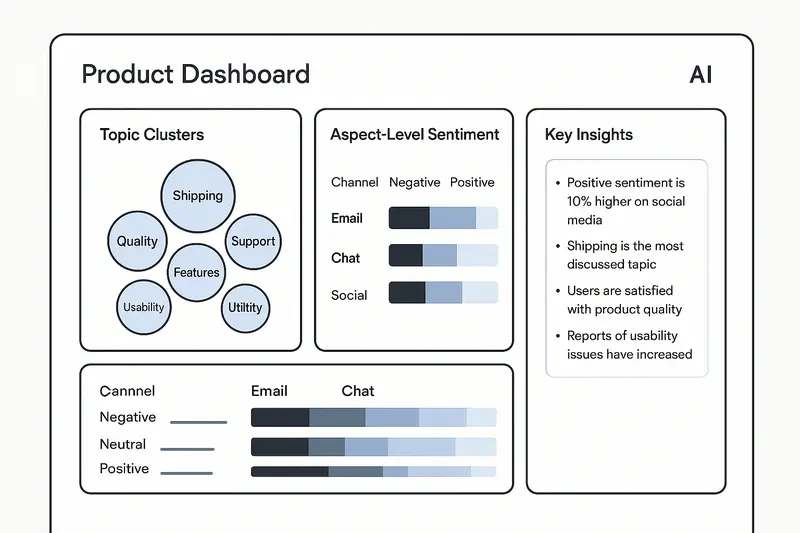
What AI customer feedback analysis really means
At its core, AI reviews unstructured text at scale, detects topics, reads sentiment by aspect, and surfaces patterns you would otherwise miss. The edge is consistency and coverage. Every ticket, post, and review gets the same careful parse, no shortcuts.
- Definition: automated collection, categorization, and interpretation of customer feedback using NLP and ML.
- Beyond sentiment: detect themes, root causes, and segment differences, then link insights to outcomes.
- Why now: volumes are too large for manual work, and leaders need faster, clearer signals.
For a primer on conversation-level sentiment and why context matters, see Observe.ai’s glossary on sentiment analysis (https://www.observe.ai/contact-center-glossary/sentiment-analysis).
From reactive to proactive
Most teams used to react after scores dipped or churn rose. AI flips the model. Predictive analytics spots subtle changes in tone and behavior before they snowball. Teams intervene earlier, with targeted support and fixes.
- Early warning: models flag patterns that precede churn or repeat contacts.
- Faster motion: organizations act sooner and retain more accounts, improving revenue efficiency.
See a simple breakdown of churn modeling benefits at Phoenix Strategy Group (https://www.phoenixstrategy.group/blog/predictive-analytics-reduces-customer-churn).
Tooling landscape in 2026
There is no one-size platform, only tradeoffs.
- Enterprise platforms: broad ingestion, deep analytics, tight governance. Great for large VOC programs.
- Specialized solutions: focus on theme discovery, research repositories, or in-product capture.
- Integrated product analytics: connect what users say with what they actually do.
Where Sleekplan fits: a focused, approachable toolkit for product teams that want automated triage, theme detection, and clear workflows without heavy implementation.
If you want a quick view of autopilot-style parsing from support and calls, review Harvestr’s AI feedback analysis overview (https://harvestr.io/product/ai-feedback-analysis).
Core technologies, briefly
NLP and aspect-level sentiment
Modern NLP reads intent and emotion, not just keywords. It handles mixed signals in one comment, like praise for UX but frustration with billing. Real-time analysis also unlocks live coaching and immediate remediation when needed.
Machine learning models
From simple classifiers to deep nets, the model choice depends on data volume, complexity, and the need for explainability. The goal is stable classification across channels and time periods.
Data preparation and quality
Clean input, better output. Standardize casing, handle emojis and negations, deduplicate, and fix typos. Consistency across channels is non-negotiable if you want comparable insights.
Generative AI
Use domain-tuned models to summarize, cluster, and extract reasons behind sentiment shifts. Vertical models trained on CX data will outperform generic LLMs. For a view on the predictive layer and verticalization, read Sprinklr’s guidance on customer feedback and predictive analytics (https://www.sprinklr.com/blog/customer-feedback-management-and-predictive-analytics/).
A practical framework you can run this quarter
-
Set sharp objectives Decide what you will improve and how you will measure it. Reduce churn in self-serve by 3 percent, cut bug-related tickets by 20 percent, or ship top-5 themes to roadmap within 60 days. Vague goals stall programs.
-
Capture feedback across channels Email, in-product prompts, support tickets, reviews, and social. Centralize collection so nothing gets lost. Right survey for the job: transactional near the moment, relationship on a cadence.
-
Prepare your data Normalize text, fix obvious noise, unify taxonomies. Build privacy into the pipeline with clear consent, retention, and deletion paths.
-
Apply AI analysis Detect themes, aspect sentiment, and intent. Let discovery surface new topics, then pressure-test with humans. Distill root causes, not just labels.
-
Prioritize by impact and urgency Score by sentiment severity, frequency, ARR at risk, and strategic fit. Make tradeoffs explicit so the team understands why one fix beats another.
-
Close the loop Tell customers what changed and why. Share updates in product and publicly. A short, specific note beats a generic thanks.
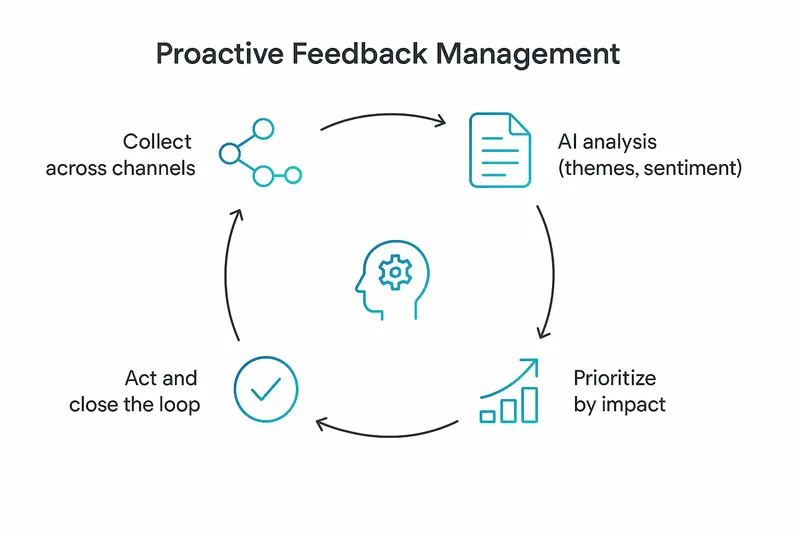
Where Sleek Intelligence shines
We built Sleek Intelligence to make analysis and triage simple, then keep humans in charge of decisions.
- Topic theme detection: automatic clustering of recurring ideas that maps to how customers actually speak.
- Automation rules: apply filters, then act at scale. Example: close posts with fewer than five votes created in the last 365 days, add a short explanation, and keep the thread available for future interest.
- Flexible workflows: tag by segment, route to owners, or update status in bulk. Consistency without busywork.
Turn insights into communication with Sleekplan’s public-facing tools. Share what shipped using Sleekplan’s Changelog features (https://sleekplan.com/features/changelog/). Align stakeholders with a living plan on the Roadmap (https://sleekplan.com/features/roadmap/). Capture structured input through Feedback Boards (https://sleekplan.com/features/feedback-boards/), then announce improvements where users will see them using Announcements (https://sleekplan.com/features/announcements/).
Advanced analytics for churn prevention
Blend qualitative signals with product usage to spot risk early. Look for:
- Sentiment drift from promoters to neutral over two release cycles.
- Ticket clusters tied to a critical workflow step.
- Drop in weekly active usage among accounts with recent negative comments.
Move fast on the high-risk segment with targeted outreach, education, or product fixes. The compounding effect is retention first, then expansion.
Privacy, compliance, and trust
Design for consent, explain how feedback is used, and make deletion simple. Map retention windows and access controls to each data source. For a deeper look at GDPR and feedback programs, see Pisano’s overview (https://www.pisano.com/en/academy/how-gdpr-compliance-affects-customer-feedback-collection).
How to prove ROI
Start with the math, not the tool count.
- Tie initiatives to KPIs: churn, NRR, time to resolution, CSAT, adoption.
- Track before and after, use control groups where possible.
- Report specific wins, for example, “reduced bug-related tickets 23 percent in 60 days” or “moved 4 top themes from idea to shipped in one quarter.”
Qualtrics offers a straightforward framing for CX ROI calculation if you need a refresher (https://www.qualtrics.com/articles/customer-experience/customer-experience-roi/).
Quick answers
- What is AI customer feedback analysis? Automated analysis of multi-channel feedback using NLP and ML to surface themes, sentiment, and actions.
- Which ai tools are best? Pick based on data sources, governance needs, and team size. Ensure domain-tuned models and clear workflows.
- How fast can we see value? In weeks, if you start narrow. Begin with one or two channels, automate triage, and ship improvements. Expand from there.
- Do we still need humans? Yes. AI handles scale and consistency, humans handle judgment and tradeoffs.
Final take
Quality beats volume. When analysis is precise, priorities get sharper, roadmaps get cleaner, and customers feel heard. AI is not the strategy, it is the amplifier. Pair strong product judgment with clear loops for collection, analysis, prioritization, and communication, and your feedback system becomes an engine for retention and growth.