The landscape at a glance
Dovetail alternatives are usually evaluated for one of two reasons: the tool stopped fitting the workflow, or the bill stopped making sense. Teams searching for alternatives to Dovetail are not just swapping tools, they are rethinking how research and feedback flow through the product stack. AI is strong, repos are smarter, Dovetail pricing is now quote-led, and workflows matter more than ever.
Why alternatives to Dovetail matter now
Dovetail is a mature insights platform used by large companies, but recent changes and new pricing dynamics have teams exploring options. Its Sun’s Out launch on 14 July 2026 pushed the product further toward AI: Digital Twins that answer questions as a customer segment, Agents moved to general availability, Channels 2.0, and first-party MCP connectors. That is a different product from the research repository many teams originally bought, and it arrives with a different bill.
Principle: pick tools that reinforce your workflows, not the other way around.
How much does Dovetail cost in 2026?
Dovetail publishes no paid price. When we checked Dovetail’s own pricing page on 20 September 2026 it listed exactly two options, a Free plan at $0 per user per month and an Enterprise plan marked “Custom pricing available”, with nothing in between. There is no public per-seat rate card and no published middle tier, so every paid Dovetail deal starts with a sales conversation.
That matters more than a sticker price would. A published rate lets you model what happens when six more people need access next quarter. A quote does not, and that gap is where research budgets get surprised at renewal.
| Free | Enterprise | |
|---|---|---|
| Price | $0 per user per month | Custom, contact sales |
| Channels | One | Unlimited |
| Projects | One | Unlimited |
| AI chat | Scoped to a single project | Unlimited queries, from Slack and Teams |
| AI Agents | Not included | Unlimited |
| Dashboards | Not included | Included |
| Governance | Not included | Redaction, compliance, access control |
Both columns were read off Dovetail’s pricing page on 20 September 2026 and can change without notice, which is rather the point.
Which plan gates Dovetail’s AI analysis?
Dovetail gates its AI by volume rather than by capability. The Free plan does include AI chat and automatic summaries, but both are confined to one project and one channel, so the AI reasons over a slice of your data instead of the whole repository. Enterprise removes the counting limits: unlimited projects, unlimited channels, unlimited Docs, unlimited Agents, plus semantic search and structured summaries.
Dovetail’s Sun’s Out launch post states that Digital Twins and AI Agents are available on all paid plans. Because the public ladder has exactly one paid plan, that sentence resolves to a sales call rather than an upgrade button.
The shape is common enough to have a name. a16z’s guidance on pricing and packaging generative AI features, published in March 2024, describes companies that “include basic genAI features in a core or lower-paid tier and gate better-performing genAI features or more genAI usage in a higher tier”. Working out which half you are being sold is most of the evaluation.
If AI analysis of research and feedback is the job you are hiring for, compare that shape against a published one. Sleek Intelligence meters the same kind of work in credits you can count before you buy: 1,000 on Starter, 5,000 a month on Business.
What per-seat pricing does when non-researchers need access
Dovetail prices per user, and the people who cost money are the ones who build and analyse, not the ones who read. The Free plan is labelled per user per month, so the model is seat-based, yet Dovetail publishes no seat rate, no seat minimum and no separate viewer price. The one public concession sits on the Enterprise plan, which lists unlimited free chat queries and describes them as anyone in your organisation querying Dovetail data directly from Slack or Teams.
That distinction decides whether the tool stays with the research team or spreads across product, design and support, so price it out before you sign. a16z’s August 2026 essay You are not a model. Don’t price per token. makes the general case: “Copilots may begin with seats, then add usage-based pricing as agentic work creates greater variation in cost and value.” In a survey of 50 technical AI buyers reported in that essay, 27 preferred credits tied to recognizable work and only 14 preferred raw token pricing.
Questions to ask before you sign
Dovetail’s annual terms are not published anywhere we could verify, so these have to be asked rather than looked up:
- What is the per-seat rate, and does it differ for editors, admins and read-only users?
- Is there a seat minimum, and what does the eleventh seat cost mid-term?
- What is the annual discount against monthly, and is monthly billing offered at all?
- Are Digital Twins, Agents and semantic search inside the quoted price, or metered separately?
- What happens to your projects, Docs and transcripts if you do not renew?
We could not verify Dovetail’s annual discount, contract minimum or seat taxonomy from any public source in September 2026. Treat all three as negotiation items, not as published facts.
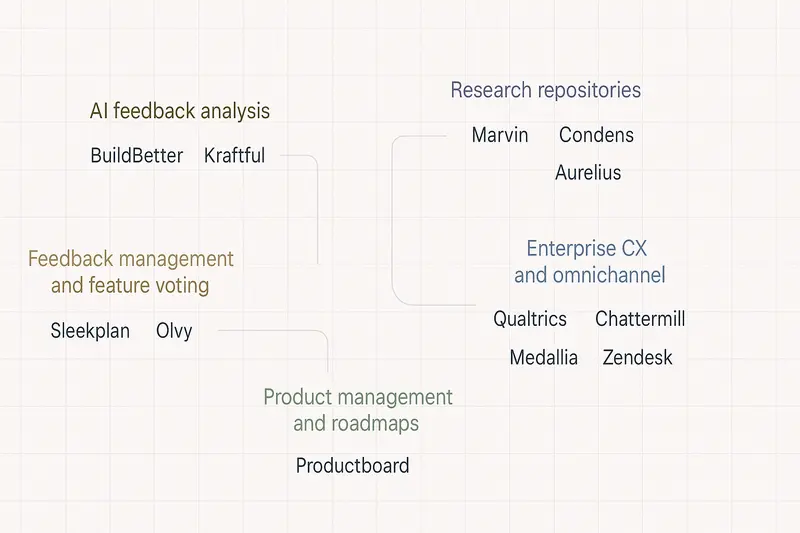
AI feedback analysis: BuildBetter and the new wave
BuildBetter leans into automation. Its universal AI search and chat turn messy calls, tickets, and surveys into direct answers in minutes.
Kraftful advanced accuracy with hallucination detection, then was acquired by Amplitude in July 2025. Its standalone platform shut down on 11 August 2025 and customers were migrated across, so Voice of Customer analysis now lives inside Amplitude’s analytics suite rather than as a separate product you can buy. Read the acquisition details: Amplitude acquires Kraftful.
Signals to look for:
- Speed to first insight with minimal prompting
- Pattern accuracy on unstructured data, not just keywords
- Integrations that reduce copy-paste work
Takeaway: AI should accelerate your judgment, not replace it.
Research repositories: Marvin and Condens set the tone
Marvin is purpose-built for fast tagging, transcript accuracy, and low-edit AI workflows.
Condens focuses on clarity. Split-screen tagging keeps you close to source material and themes at the same time. Large teams have even migrated overnight with hands-on help, showing that switching costs can be managed with the right partner.
Aurelius keeps pricing simple with unlimited users, which scales smoothly for growing teams. It centralizes notes, tags, and insights, then keeps retrieval fast, even if report customization is lighter than some.
Principle: your repo is a memory system. Speed, structure, and retrieval beat bells and whistles.
Feedback management and product comms: lean, visible, continuous
Olvy helps product teams centralize feedback and surface insights fast, keeping a tight pulse on user needs.
Sleekplan emphasizes feedback ops plus communication in one flow:
- Capture requests on a public or private board with sorting and merging
- Turn decisions into a visible plan with a shareable roadmap
- Close the loop with a clean changelog and targeted surveys
Useful links if you are evaluating Sleekplan:
- Bring requests in from every channel with a customer feedback tool
- Turn decisions into a visible plan with a roadmap tool
- Close the loop using a changelog tool
Reality check: teams pick tools they can actually maintain. A tight feedback-to-communication loop keeps momentum.
Product strategy and roadmaps
If your pain is prioritization and alignment, Productboard stands out. It maps feedback to strategy and delivery, though it can feel heavier at first. The tradeoff is power where roadmaps meet reality.
Digital analytics and behavior-rich context
If you need journey analytics and mobile depth, platforms like Glassbox add session replay, funnels, and performance context. Pairing behavioral data with qualitative feedback brings sharper answers to why-and-how questions.
Enterprise-grade and omnichannel
Qualtrics, Chattermill, and Medallia handle complex VOC at scale, across surveys and unstructured channels. Zendesk captures feedback where service happens, then routes insights across teams. These tools shine when your feedback sources span the entire customer experience.
Principle: omnichannel only pays off if insights reach owners who can act.
Pricing signals to watch
Cost is not just price. Look at how the model scales with seats, data volume, and collaboration, because those three lines are what move a number between renewal years.
- Per seat: cheap at five people, painful once support and design want in
- Per credit or usage: forecastable when the unit is something you already count
- Quote only: no public rate card, so budget from your own last invoice
- Free tier: check what it is scoped to, not only what it is called
Sleekplan publishes its numbers instead of quoting them. Indie is free forever, Starter is $15 a month or $13 billed yearly with 3 team seats, and Business is $45 a month or $38 billed yearly with 10, each paid plan carrying a 30-day trial with no card. The full grid sits on the pricing page.
A simple selection framework
Pick by the job to be done, not by the loudest feature list.
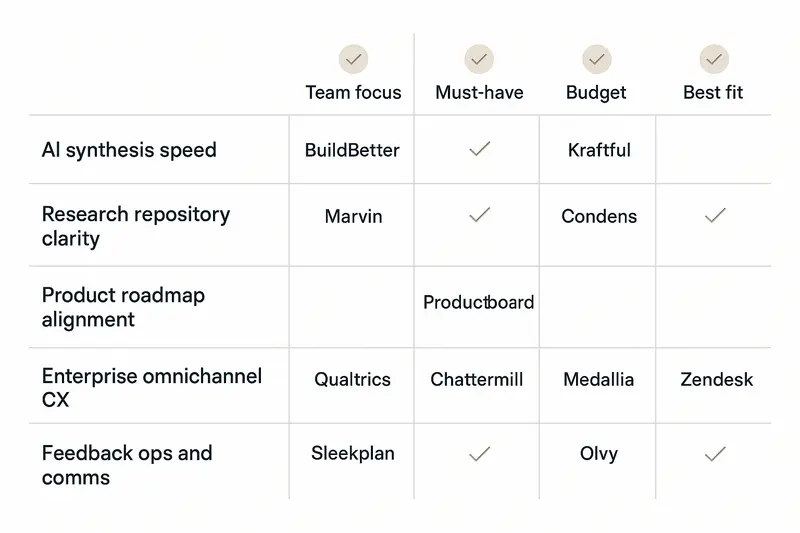
- Need fast AI synthesis: BuildBetter, Kraftful inside Amplitude
- Need a modern research repo: Marvin, Condens, Aurelius
- Need roadmap execution: Productboard
- Need omnichannel CX insights: Qualtrics, Chattermill, Medallia, Zendesk
- Need feedback ops and comms: Sleekplan, Olvy
Heuristic: choose the tool that cleans your signal path from user input to shipped change with the least friction.
Real-world patterns we see
- AI earns trust when edits are low and repeatability is high
- Repos win when search is instant and tags are consistent
- Product comms work when roadmaps and changelogs are living, not static
- Enterprise value shows up when insights route to owners automatically
Quick answers
- What are the best alternatives to Dovetail? For AI speed, BuildBetter. For repos, Marvin or Condens. For product strategy, Productboard. For integrated feedback ops, Sleekplan.
- What does Dovetail cost? Its pricing page showed only a free plan and a custom-priced Enterprise plan on 20 September 2026, so the paid number comes from a quote.
- Which options are most affordable? Sleekplan’s free Indie plan and $13 Starter are the lowest published entry points here. Dovetail does not publish a paid price at all, so its floor cannot be compared on paper.
- How do I choose the right fit? Rank your top two jobs: synthesize insights, store research, plan roadmaps, or manage omnichannel VOC. Then pick the leader in that lane.
- What if I just need feedback to roadmap to changelog? A lean stack like Sleekplan keeps the loop tight and visible.
Craft over speed
We believe quality research and clear communication win. Pick tools that respect your process and help your team ship with confidence. If feedback-to-roadmap-to-changelog is your backbone, keep it simple and owned end to end.