The tension you feel is structural, not personal
If you force platform teams to own direct revenue, you break the machine. Balancing platform and revenue teams starts with accepting they create value differently. The work looks similar from the outside, yet under the hood the economics diverge.
Leaders who blur this line end up with two bad outcomes. Platform focus erodes into short-term revenue theater. Revenue teams slow down because the enabling rails never arrive. The fix is clarity, then orchestration.
Different value models, different language
Revenue teams create direct, attributable value: pipeline, bookings, NRR, LTV. A deal closes, ARR moves. Singular impact, short feedback loops.
Platform teams create multiplicative, distributed value. They shorten lead time, improve reliability, and remove toil across many product teams. That value compounds yet rarely shows up cleanly in the P&L. Forcing platform to speak in ARR targets invites distortion. The logic does not translate cleanly, as argued in the ProdPad note that platform teams are not revenue teams.
The takeaway: measure each function on the outcomes it actually controls. Then connect the dots across functions with intent.
RevOps is the bridge
Revenue Operations exists to stitch these worlds together. It aligns marketing, sales, success, finance, and product around shared metrics and clean handoffs. Adoption is high, maturity is not. Accenture reports strong momentum for RevOps, plus a wide execution gap that still needs closing. Read their overview on the new RevOps imperative.
RevOps depends on platform services: data pipelines, integrations, analytics, governance, and workflow automation. Platform depends on RevOps for business context and prioritization. Tight integration turns platform from a perceived cost center into a force multiplier for revenue execution.
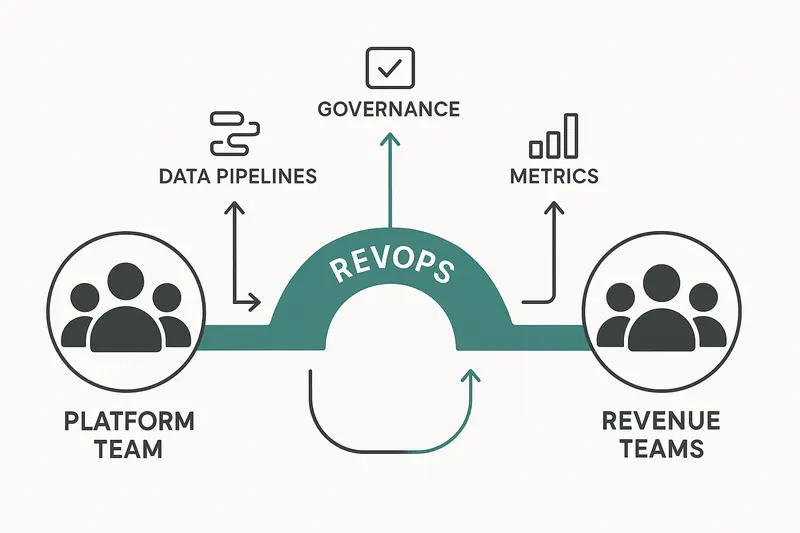
Principle: keep roles distinct, build strong connective tissue.
Structures that protect focus and speed
- Stream-aligned product teams own customer outcomes.
- Platform teams own enabling services and internal capabilities.
- Revenue teams own acquisition, expansion, and retention.
- RevOps owns orchestration and shared process.
Separate decision rights, shared outcomes. Platform leadership decides on architecture, tooling, and internal developer experience. Revenue leadership decides on customer strategy and GTM. Executive forums align priorities and resolve trade-offs without collapsing roles into one bucket.
OKRs that make platform work visible
Most OKR pain is a framing problem. Write platform OKRs as enablement outcomes, not feature lists.
Examples you can lift:
- Enable deployment frequency to move from weekly to daily for 80% of product teams.
- Improve API reliability to 99.95% for tier 1 services.
- Cut new service onboarding time from 3 days to 1 hour.
- Reduce mean time to recovery to under 30 minutes for critical incidents.
This language is honest, testable, and valuable. It respects the craft.
Platform metrics that matter
You do not need to pretend platform creates ARR. You do need crisp metrics that prove leverage. The platform community has converged on a practical stack, summarized well in metrics that matter for platform success:
- DORA for flow and safety: deployment frequency, lead time for changes, MTTR, change failure rate.
- Developer experience: internal NPS for platform, task success rate, onboarding time, time to first deploy.
- Adoption and utilization: percent of eligible teams using capabilities, version drift, upgrade cadence.
- Cost efficiency: infra cost per developer, consolidation savings, resource utilization.
Pair these with a few cross-functional outcomes in exec reviews, not as a translation into revenue, but as a portfolio view.
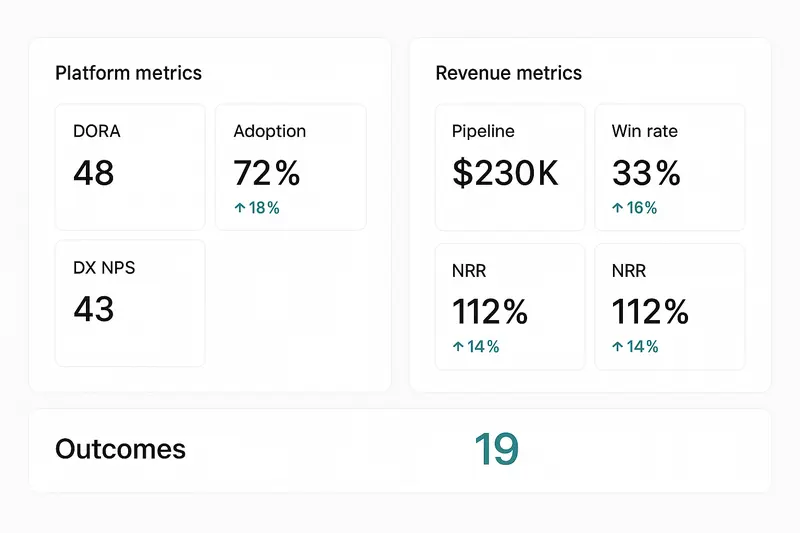
Tip: show the before and after. Example, “Provisioning dropped from 3 days to 45 minutes, bugfixes within 7 days climbed from 62% to 88%.” Numbers cut through noise.
Revenue team metrics without blind spots
Revenue teams still need balanced scorecards: leading indicators to encourage proactive motion, lagging indicators to confirm outcomes.
- Leading: pipeline creation, qualified opportunities, win rate, proposal velocity, expansion pipeline.
- Lagging: bookings, ARR, NRR, churn, CAC payback.
- Shared KPIs: qualified pipeline across sales and marketing, NRR across sales and success, feature adoption across product and sales.
Shared KPIs force shared definitions. Alignment follows measurement.
Collaboration architecture that kills silos
Silos are usually structural, not interpersonal. Create collaboration by design.
- Rituals: weekly RevOps sync, monthly cross-functional business review, quarterly planning with platform plus revenue leaders.
- Shared data: single customer and account truth, shared telemetry, visibility into handoffs and SLAs.
- Working agreements: explicit owners, entry and exit criteria, and escalation paths.
Make information public by default. Fewer closed doors, more shared dashboards.
Governance rhythms that scale
Set a simple cadence that holds, even during crunch time:
- Quarterly strategy alignment: map platform bets to revenue priorities, and sequence.
- Monthly executive review: a single KPI view for platform, product, and revenue. Resolve resource conflicts in the room.
- Weekly operational sync: short, unblockers only.
- Quarterly feedback loop: structured input from product and revenue teams to shape the platform roadmap.
The rhythm is the product. Protect it.
Platform adoption is earned
Mandates create surface adoption and shadow tooling. Real adoption spreads when the platform removes pain faster than teams can replicate the fix.
Start small, pick visible pain, over-support pilots, then scale:
- Choose 2 to 3 pilot teams with high friction and high influence.
- Fund concierge onboarding, office hours, and golden paths.
- Ship speed wins: lead time from days to minutes, paved paths for auth, logging, and deploys.
- Capture developer quotes and time-saved deltas, then broadcast.
Champions matter. Recruit engineers and EMs as peer trainers and signal boosters. Social proof beats policy.
Advanced measurement, without bogus causality
You can correlate platform improvements to business outcomes without over-claiming causality. Build a metadata layer that links services to owners, product areas, and revenue streams. Track deploy success, incident rate, and recovery time per service. Then examine relationships with CSAT, feature adoption, and churn for those services.
Executives do not need a perfect equation. They need consistent evidence that better delivery correlates with better customer outcomes.
Technical debt vs feature development
Do not force these to fight for the same calories. Separate swimlanes or budgets, then set a floor for debt work. Many teams hold 15 percent of capacity for debt and reliability. Platform investment lowers the denominator for every future feature, so underfunding it mortgages velocity.
Good test: if the team cannot ship critical fixes without multi-week regressions, you are underinvested in platform.
Platform consolidation and AI raise the bar
Tool sprawl punishes both RevOps and engineering. The market is moving toward fewer, integrated systems. See Outreach’s perspective on platform consolidation. Consolidation reduces integration drag, but it increases the need for strong data governance and cross-functional design. That is platform territory.
AI ups the stakes. Revenue teams get guidance on lead quality, deal risk, and next best action. Platform teams get predictive scaling, automated remediation, and smarter runbooks. None of this works without clean data, lineage, and observability. Consolidation is an AI precondition, not a nice-to-have.
Quick answers
- What should platform teams be accountable for? Developer velocity, reliability, adoption, and cost efficiency, not bookings.
- Who should platform report to? Technology leadership with C-suite sponsorship, plus joint governance with revenue leadership.
- How do we show platform ROI? Before and after deltas in flow, reliability, adoption, and cost, presented next to revenue outcomes in portfolio reviews.
- Where does RevOps fit? As orchestrator of shared process, data, and handoffs across marketing, sales, success, product, and platform.
Using feedback to align bets
Feedback is the connective tissue between internal enablement and customer outcomes. Route product feedback, sales notes, and success signals into one place, then use them to prioritize platform and revenue bets together. If you want AI-supported insight from customer feedback without more tool sprawl, explore Sleekplan Intelligence.
Closing thought
Clarity first, then connection. Honor how each function creates value, measure them on what they control, and let RevOps stitch the seams. Do that with care and you get compound speed, fewer handoffs gone wrong, and a calmer roadmap that actually ships.