Two layers, one goal: better product decisions
AI is no longer a novelty in product work. In 2026, the Top AI Tools for Product Managers sort into two layers: a productivity layer that cuts busywork, and a capability layer that reveals patterns at scale. This guide maps both, starting with Sleekplan’s Sleek Intelligence, then nine more tools that earn a place in a modern PM stack.
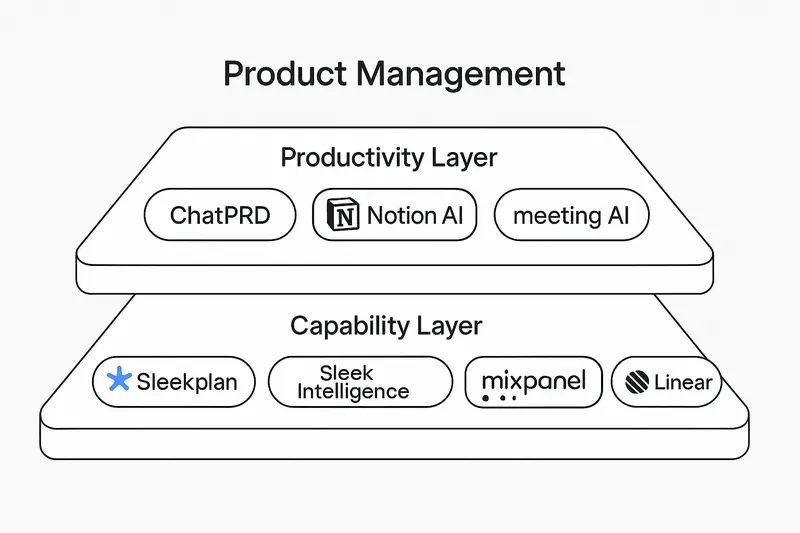
The two-layer model for AI in product management
- Productivity layer: drafting PRDs, summarizing meetings, synthesizing notes.
- Capability layer: feedback analysis, behavior analytics, timeline prediction.
Great teams use both. Save hours on docs, then invest that time in higher signal analysis.
Sleek Intelligence: integrated AI for feedback that scales
Sleek Intelligence sits inside Sleekplan, not bolted on. It supports the full loop, from multi-source collection to analysis and action. Explore what ships today on Sleekplan’s Sleek Intelligence page.
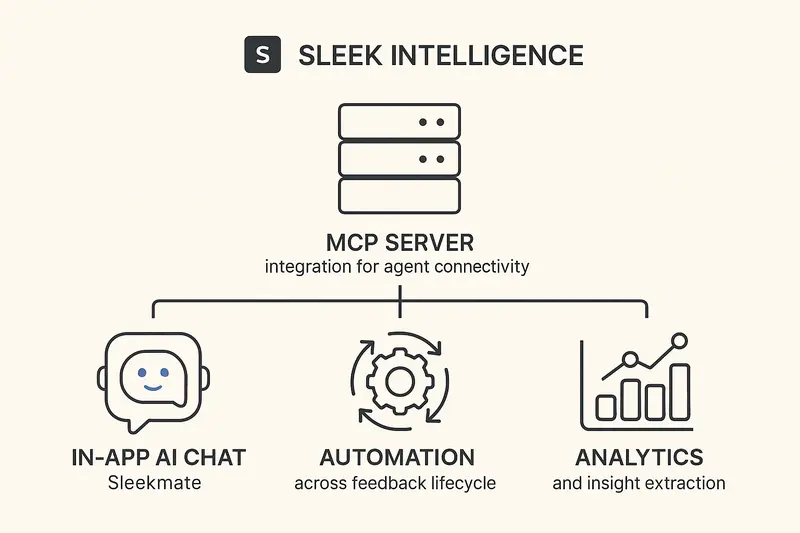
1) MCP Server for standards-based agent connectivity
An MCP Server exposes feedback APIs through a common protocol, so new AI agents plug in without custom work. As your stack evolves, the interface stays stable and secure. Fewer fragile point-to-point integrations, faster discovery of new agent use cases.
2) In-app AI agent, Sleekmate
Sleekmate answers questions directly in Sleekplan. Ask for themes across this quarter’s feedback, or how to configure NPS, without hopping tools. Embedded context means better answers, less time lost to switching.
3) Automation across the feedback lifecycle
Collection from reviews, social, and support, auto-merge of duplicates, and moderation rules keep the portal tidy. The result, a single source of truth instead of fragmented signals.
4) Analytics and insight extraction
AI surfaces themes, sentiment shifts, and outliers worth a closer look. Think “pricing friction spiking in EMEA” or “onboarding confusion tied to one flow.” Pattern recognition at team scale, not intern scale.
- Communicate outcomes with a clean Changelog.
- Align plans on a public Roadmap.
- Capture structured input via in-app Surveys.
- Connect your stack with native Integrations.
Top AI Tools for Product Managers in 2026
Below is the short list we would trust in production. Each tool plays a clear role.
1) Sleek Intelligence, for feedback management and analysis
Integrated MCP connectivity, in-app agent, automation, and analytics inside Sleekplan. Best for teams who want feedback to drive the roadmap without drowning in noise.
2) ChatPRD, for fast, consistent PRDs
Generates structured PRDs with user stories and edge cases from rough notes. Templates raise the floor for new PMs, while integrations push drafts to Jira or Confluence. Learn more at ChatPRD.
3) Productboard, for AI-enhanced centralization
Clustering, theme detection, and executive-ready summaries turn a feedback inbox into prioritization input. See an overview of its AI direction on this analysis from Replit’s PM tools roundup.
4) Aha!, for strategy and portfolio roadmaps
All-in-one strategy, ideas, docs, and roadmaps with AI-assisted summaries. Powerful for multi-product portfolios, though heavier to implement.
5) Linear, for execution visibility
AI triage and timeline hints based on team history reduce status churn. Useful when stakeholders want dates grounded in data, not guesswork.
6) Dovetail, for qualitative research at scale
Transcribes interviews, tags themes, and produces reports that move faster than manual coding. Start with their overview of AI analysis in research at Dovetail.
7) Notion AI, for workspace synthesis
Summarize meetings, draft specs, and query your knowledge base in plain language. Ideal if your team already lives in Notion.
8) Mixpanel, for AI-driven product analytics
Conversational queries, AI Metric Trees, and session highlights translate behavior into decisions. Details on their AI suite at Mixpanel AI.
9) Figma AI plus v0, for fast concept-to-mockup
Generate UI from prompts, iterate on layout and accessibility, then validate direction before pulling engineers in.
10) Zeda.io, for focused feedback trend detection
Auto-categorizes feedback and flags emerging themes. Strong fit for PLG teams with high volume and constant requests.
How we assemble a modern PM stack
- Feedback and insight: Sleek Intelligence for collection, deduping, and analysis.
- Prioritization: Productboard or Linear scores plus customer impact.
- Specs: ChatPRD for first drafts, human edits for clarity.
- Build and track: Linear for execution, with simple weekly rollups.
- Measure impact: Mixpanel for usage shifts, Dovetail for why behind the numbers.
- Communicate: ship notes in a tight Changelog within 24 hours of release.
Principle: let each tool do one job exceptionally well, then stitch them together. Human judgment sits in the middle.
Fast answers to common questions
-
What are the best AI tools for product managers in 2026? Sleek Intelligence, ChatPRD, Productboard, Aha!, Linear, Dovetail, Notion AI, Mixpanel, Figma AI, and Zeda.io.
-
How do I choose the right stack? Start with your bottleneck. If feedback is messy, fix that first. If specs lag, add ChatPRD. If execution dates slip, pair Linear with historical velocity.
-
Will AI replace product managers? No. AI removes toil and reveals patterns. PMs still set goals, weigh tradeoffs, and own outcomes.
What good looks like
- Consolidate feedback sources within a week, enable dedupe, set moderation rules.
- Publish a public roadmap with clear statuses and estimated months, then update weekly.
- Timebox PRD drafting to 60 minutes with AI, spend the next 60 on edge cases and risks.
- After each release, post a changelog entry the same day, then survey targeted cohorts one week later.
The result, fewer meetings about what to build, more clarity about why, and fewer surprises at launch.