The new era of product management is defined by outcome ownership, continuous discovery, and faster execution with AI. For SaaS teams, that means product managers create value less through process and documentation, and more through judgment, customer understanding, and clear decisions.
In practice, teams win by measuring customer and business outcomes, running discovery every week, and turning feedback into roadmap decisions instead of collecting requests and shipping on schedule.
What is the new era of product management?
The new era of product management is a shift from feature delivery to outcome ownership. Product teams are expected to learn continuously, work across functions, and stay accountable after launch, not just until a feature ships.
Three definitions help make that shift concrete:
- Product operating model: an approach where persistent cross-functional teams own customer problems and outcomes instead of fixed feature lists. SVPG offers a useful overview.
- Continuous discovery: an ongoing habit of talking to customers, mapping opportunities, and testing assumptions alongside delivery. Product Talk explains the core practices.
- Outcome-based roadmap: a roadmap organized around measurable goals and the bets that may achieve them. Initiatives can change when evidence changes.
For SaaS teams, this matters because recurring revenue depends on adoption, retention, and expansion. Those are outcome problems, not output problems.
What is changing right now?
Several shifts are happening at once:
- Success is measured by activation, retention, revenue, satisfaction, and time-to-value, not just shipped features.
- Roadmaps are becoming living systems that update as teams learn.
- Discovery is moving from occasional research to a weekly operating habit.
- AI is speeding up research synthesis, drafting, and execution, which puts more weight on product judgment.
- PM roles are becoming more specialized, while core PM work demands stronger data, UX, and communication skills.
A quick comparison makes the change easier to see:
| Dimension | Earlier model | New model |
|---|---|---|
| Success signal | Features shipped on time | Customer and business outcomes improved |
| Team structure | Temporary project teams | Persistent product teams |
| Roadmap style | Static, timeline-led | Outcome-led, evidence-updated |
| Discovery cadence | Upfront or skipped | Continuous |
| PM value | Process and artifacts | Judgment, prioritization, influence |
Why is this shift happening now?
Three forces are driving it:
- Technology: AI and analytics shorten research, writing, and prototyping cycles.
- Market pressure: SaaS buyers expect products to improve quickly and reduce time-to-value.
- Organizational change: More companies are adopting product-oriented team structures. McKinsey has documented the business impact of product and platform operating models.
The result is simple: shipping is faster, so choosing the right problems matters more.
How SaaS product teams can adapt
The most practical response is to build a product operating rhythm around outcomes, discovery, and feedback.
1. Reframe your role around outcomes
For each initiative, define the behavior you need to change and how you will measure it.
A simple checklist:
- Define the target user behavior and the metric tied to it.
- Write a one-page intent doc with the problem, stakes, constraints, outcome, and current bets.
- Make sure backlog items connect to an opportunity, assumption, or experiment.
- Stay accountable through rollout, adoption, and iteration.
Example: instead of aiming to ship a new onboarding checklist, aim to increase first-value completion within 48 hours for a defined segment.
2. Run a weekly continuous discovery loop
High-performing teams do not treat discovery as a phase. They make it routine.
A lightweight weekly loop:
- Run one customer touchpoint, such as an interview, usability session, or prototype test.
- Synthesize what you learned and update your opportunity map or decision notes.
- Test one key assumption around value, usability, feasibility, or viability.
- Adjust roadmap bets based on the new evidence.
- Share a short stakeholder update with the outcome, signal, decision, and next step.
This rhythm works well for SaaS teams because it fits real product work. You can keep shipping while still learning.
3. Use AI to remove low-value PM work
AI is most helpful when it reduces manual overhead without replacing product judgment.
Useful applications include:
- Synthesizing themes from interviews, support tickets, and survey responses
- Drafting product briefs or specs from structured inputs
- Summarizing meetings and extracting decisions or risks
- Creating first-pass market or competitor briefs that you then validate
- Helping teams query behavior data in plain language before deeper analysis
A few guardrails matter:
- Treat AI output as a draft, not a conclusion.
- Prefer proprietary product data over generic patterns.
- Review assumptions, missing context, and edge cases before acting.
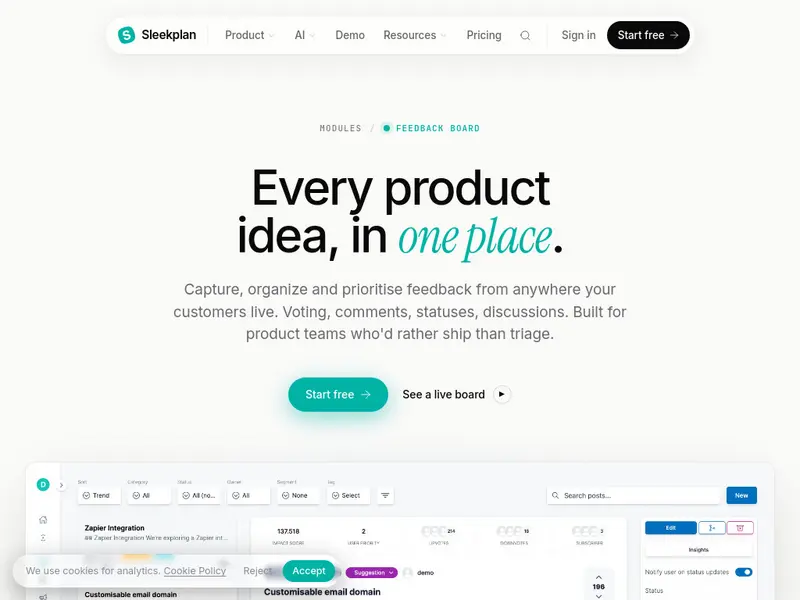
Teams using Sleekplan’s product feedback tool and Sleek Intelligence can centralize feedback, cluster themes, and turn signals into clearer product decisions and customer updates.
4. Make the roadmap a decision system
A useful roadmap should help teams decide what to keep backing, what to revisit, and what to stop.
A practical structure:
- Organize the roadmap around outcomes and bets
- Assign an owner, leading indicator, lagging indicator, and review date to each bet
- Show confidence levels and dependencies where helpful
- Update the roadmap when evidence changes, not just when timelines slip
This prevents the roadmap from becoming a promise list detached from customer reality.
5. Operationalize the feedback loop
Feedback only matters if it changes decisions and customers hear what happened.
A simple workflow:
- Centralize feedback from portals, support, sales, and in-app prompts.
- Tag it by segment, use case, or opportunity area.
- Review themes regularly and connect them to outcomes, not just requests.
- Ship small changes and measure leading indicators.
- Close the loop with customers when you start, ship, pause, or decline work.
If you want a deeper workflow, see How to Automate Customer Feedback Into Product Changes.
6. Strengthen the human skills that matter more now
As AI handles more drafting and synthesis, the human part of product work becomes more visible.
The skills that matter most are:
- Judgment: deciding what matters and what does not
- Storytelling: explaining evidence, tradeoffs, and decisions clearly
- Influence: aligning stakeholders without relying on authority alone
- Ethics and governance: protecting customer trust when data and AI are involved
Common mistakes to avoid
Teams adopting this model often run into the same problems:
- Relying too heavily on AI summaries without direct customer contact
- Treating the roadmap like a contract instead of a learning tool
- Jumping from requests to solutions without clarifying the opportunity
- Shipping faster without improving measurement discipline
- Expecting continuous discovery to work without time, coaching, or role clarity
These are not reasons to avoid the shift. They are signs that the operating model needs support.
A 90-day plan to upgrade your product practice
If your team wants to move from feature delivery to outcome-led product work, start small and make the new habits visible.
Weeks 1 to 2
- Write a one-page intent for each team or product area
- Define one leading indicator and one lagging indicator per outcome
Weeks 3 to 6
- Schedule weekly customer touchpoints
- Create an opportunity map for each active outcome
- Centralize feedback intake and agree on a shared tagging system
Weeks 7 to 10
- Rebuild the roadmap around outcomes and bets
- Add review dates, confidence levels, and evidence links
Weeks 11 to 13
- Choose a few AI use cases, such as feedback synthesis, spec drafting, or meeting summaries
- Define review steps and ownership for AI-assisted work
- Document what worked and refine the workflow
What to do next
Start with one team, one outcome, and one weekly discovery habit. Then connect feedback, decisions, and roadmap changes in a visible system your team can maintain.
That is the practical core of the new era of product management. Faster shipping matters, but better judgment, tighter feedback loops, and clearer outcome ownership matter more.