Why teams are rethinking Olvy alternatives in 2026
The center of gravity has shifted. Product teams want fewer inboxes and more insight. If you are comparing Olvy alternatives, you are likely feeling the tension between community-driven feedback and AI-driven analysis. The right tool should convert noise into clear, accountable work, then close the loop for users.
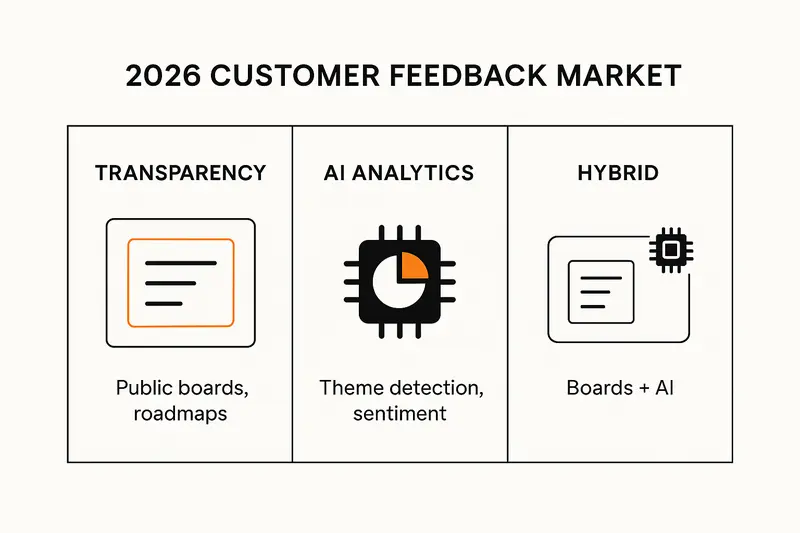
The market split: three workable philosophies
Feedback tooling now follows three paths. All valid, each with tradeoffs.
- Transparency: public boards, voting, and a visible roadmap. High trust, clear expectations.
- AI analytics: unify tickets, chats, surveys, and reviews, then extract themes and sentiment. High depth, less public ceremony.
- Hybrid: combine boards and roadmap clarity with AI that synthesizes patterns. Balanced, faster learning.
The takeaway: choose the path that fits how your customers talk to you and how your team makes decisions.
Where Olvy fits, and where gaps appear
Olvy shines when your community lives in Slack or Discord. It pulls scattered comments into organized tasks and keeps the conversation in the channel. Pricing starts around $30 per user per month, which suits many mid‑market teams.
Limits show up when feedback sits outside community tools. If key signals live in support tickets, emails, or call notes, you will need deeper ingestion and analysis. If you want outcome validation, not just deduped requests, you will want stronger analytics.
Useful background:
- Overview of the 2026 landscape: Quickhunt on Olvy alternatives
- Olvy capabilities and pricing context: GetApp on Olvy
The standout hybrid: Sleekplan with Sleek Intelligence
Sleekplan covers the full feedback loop, from capture to communication, and adds an AI assistant that reduces manual triage.
What it looks like in practice:
- Collect feedback in-app or on a standalone board, then merge duplicates automatically.
- Detect themes across posts, votes, and comments to surface the real problem, not just the loudest request.
- Plan with a public roadmap, then close the loop with targeted updates.
Start here if you want craft and clarity, not busywork:
- Explore Sleekplan’s Sleek Intelligence
- Set up a Feedback Board
- Share a Public Roadmap
- Announce with Changelog features
- Connect your stack with Integrations
The principle: quality and ownership. Automate the grunt work, keep the judgment human.
Direct Olvy alternatives, at a glance
Many tools mirror Olvy’s public boards, roadmaps, and release notes. Differences show up in cost models, admin burden, and AI depth.
- Canny: strong public boards and roadmaps, channel agnostic, often embedded in-product. Simple to run, limited analysis depth without add-ons.
- UserJot: flat pricing with unlimited users, AI deduping, low admin overhead. Good for fast‑growing teams that hate tracked-user pricing.
- FeatureOS and Frill: clean UI, straightforward boards, roadmaps, and changelogs. Light, tidy, lower lift, less advanced analytics.
- Rapidr: budget friendly, lean feature set, fewer enterprise controls, fine for early stages.
If your priority is minimal curation with modern AI help and a polished public surface, the hybrid lane fits best.
AI‑first feedback intelligence platforms
If your main problem is volume and fragmentation, start with analysis depth. These platforms favor unification and thematic clarity over public boards.
- Kraftful: deep LLM‑native analysis, survey generation in seconds, multilingual support, and safeguards against hallucinations. Great when you already collect feedback but need sharper insight. See Kraftful.
- Thematic: targeted text analytics across tickets, surveys, and reviews, with themes and sentiment tuned for different teams. See Thematic.
- Chattermill and Unwrap: enterprise‑grade unification, granular topics, emotion drivers, and outcome tracking. High signal for mature orgs with complex data flows.
These can complement a public board tool, or replace it entirely if your focus is internal decision support.
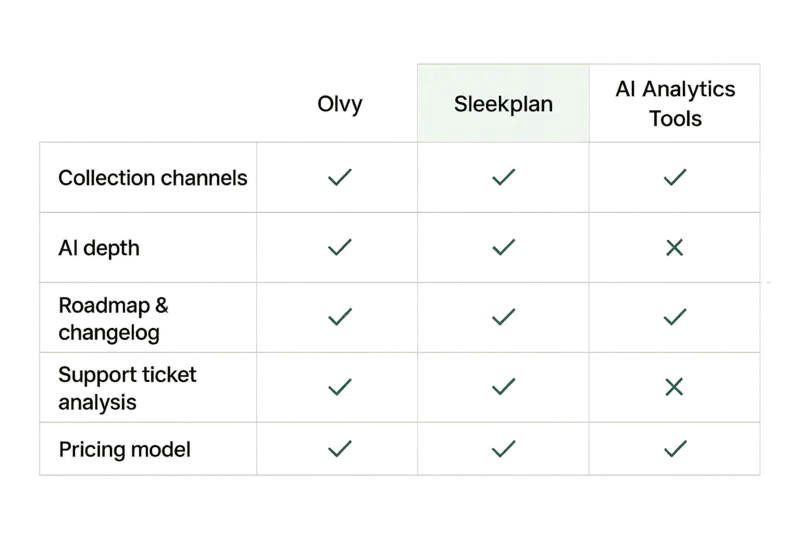
Pricing reality and integration depth
Pricing has stratified, which mirrors real use cases.
- Free or freemium: good for early validation, limited scale.
- Per user or tracked user: predictable revenue, can sting during growth spurts.
- Flat team pricing: easier budgeting, good for fast‑growing teams.
- Usage based: common for analytics and support ingestion.
Integrations are no longer nice to have. Map your stack first: Jira or Linear, Slack or Teams, Salesforce or HubSpot, Zendesk or Intercom, Amplitude or Pendo. If the tool does not meet you where you work, you will import CSVs forever.
Workflow fit matters more than feature lists
Tools that match your process save hours each week.
- Community led: Olvy or a hybrid like Sleekplan.
- Feature request led: public boards with voting and a clear roadmap.
- Support led: AI analytics that mine tickets and chats for patterns.
- Research led: qualitative synthesis across interviews and studies.
Ask: where does 70 percent of our feedback actually live today, and who acts on it?
Quick recommendations by use case
- You run active Slack or Discord communities: start with Sleekplan or Olvy. If you want AI synthesis and lighter admin, lean to Sleekplan. For pricing and capability context, see GetApp on Olvy.
- You want in‑product voting and a public roadmap: tools like Canny or UserJot are safe bets. If you outgrow manual triage, add AI or move to a hybrid.
- You need thematic analysis across support: Thematic or similar AI platforms deliver fast clarity. See Thematic.
- You need LLM‑native insights and multilingual workflow: consider Kraftful.
- You want a single loop from capture to ship to announce: try Sleekplan’s hybrid setup with Sleek Intelligence.
For a wider market scan with 2026 context, read Quickhunt’s guide.
FAQ: fast answers for buyers comparing Olvy alternatives
-
What is the best Olvy alternative for AI analysis?
- For end‑to‑end feedback with AI synthesis, Sleekplan. For pure analytics depth that ingests many channels, Thematic or Kraftful.
-
Which Olvy alternatives support public boards, roadmaps, and changelogs?
- Sleekplan, Canny, UserJot, Frill, FeatureOS. If you also need AI to cut noise and detect themes, pick a hybrid like Sleekplan.
-
How should I choose among Olvy alternatives?
- Start with your primary source of truth. Community channels, in‑app boards, support tickets, or research. Then score tools on integration fit, AI depth, and how they help you close the loop.
-
Does Olvy work best with Slack and Discord?
- Yes. That is its sweet spot, especially if you prefer straightforward deduping and task creation within those channels.
-
What pricing model is safest as we scale?
- If headcount or tracked users grow quickly, flat team pricing avoids surprises. If data volume grows faster than seats, usage based can be smarter.
The quiet craft that wins
We have learned to value the small edges: merging a duplicate before it becomes noise, shipping a fix and measuring whether complaints drop, sending the right changelog to the right users. Quality is cumulative. Tools should help you earn it, not distract from it.
For teams that care about detail and accountability, hybrid systems are the calm path. Automate the busywork, keep your roadmap honest, and tell customers what changed.
Further reading on market shifts and AI depth:
- 2026 landscape overview: Quickhunt
- AI text analytics for feedback: Thematic
- LLM‑native feedback insight: Kraftful
- Product fit and pricing context: GetApp on Olvy