Four MoSCoW worksheets you can copy straight off the page.
Sprint or release
MoSCoW worksheet: Sprint 24, 17 Nov to 28 Nov
Timebox: 10 working days. Capacity: 40 points. Release goal: self-serve trial signup.
The test every Must have had to pass: if this one item is missing on 28 Nov, we do not turn the trial on.
Must have (24 of 40 points, 60%)
Signup form with email verification · 8
Stripe checkout for the Starter plan · 8
Trial expiry job and the expiry email · 5
Audit-log entry for every plan change · 3
Should have (8 of 40 points, 20%)
Annual billing toggle · 5 · workaround: sales invoices annually by hand, three deals a month
In-app countdown banner · 3 · workaround: the expiry email already tells them
Could have (8 of 40 points, 20%)
Coupon codes at checkout · 5
Usage chart on the billing page · 3
This is the contingency pool. If the Must haves run long, these are what we drop, and dropping them breaks nothing we promised.
Won't have this time
SAML SSO · reason: no trial account has asked, and the two that will are both above 50 seats · revisit: when the first 50-seat trial starts · decided 17 Nov
Multi-currency pricing · reason: Stripe supports it, our invoicing does not · revisit: Q2 · decided 17 Nov
Effort check
Must 24/40 = 60%. Should 8/40 = 20%. Could 8/40 = 20%.
DSDM guidance: no more than 60% Must have effort, with a Could have pool around 20%. This plan is at the limit, not under it, so any new Must have has to push something else out.
Product backlog
MoSCoW worksheet: backlog triage, 17 Nov
Scope this applies to: the next release, six weeks. Items: the 12 open requests above 20 votes.
One row per item. The rationale column is the one that stops the same argument twice.
Must have
Bulk CSV import · 8 pts · 214 votes · rationale: named in four of the six deals lost last quarter, no workaround exists
Role-based permissions · 13 pts · 156 votes · rationale: blocks every account above 50 seats, legal cannot sign without it
SSO via SAML · 8 pts · 98 votes · rationale: three enterprise renewals name it as a condition
Should have
Slack notifications for status changes · 5 pts · 142 votes · rationale: painful to omit, but the weekly digest email covers it for now
Custom fields on a request · 8 pts · 87 votes · rationale: two accounts are using tags as a substitute and say it works
Could have
Dark mode in the portal · 5 pts · 76 votes · rationale: wanted, visible, and nothing stops working without it
Emoji reactions on comments · 2 pts · 54 votes · rationale: cheap, and first out if the Must haves slip
Won't have this time
Public API v2 · 21 pts · 63 votes · reason: the v1 API covers every use case in the requests, this is a rewrite disguised as a feature · revisit: after the permissions model lands · decided 17 Nov
Mobile app · 44 pts · 41 votes · reason: the responsive portal handles the two jobs people described · revisit: not this year · decided 17 Nov
Effort check
Must 29 pts. Should 13 pts. Could 7 pts. Total sorted: 49 pts.
Must share: 29/49 = 59%, just inside the 60% DSDM guidance. Could pool: 14%, thinner than the 20% DSDM suggests, so there is less to trade away than it looks.
Workshop agenda
MoSCoW workshop: 60 minutes, 8 to 12 people
Bring: the candidate list, one line per item, already written. Do not write the list in the room.
Roles: one facilitator who does not vote, one scribe, one person who owns the deadline.
0 to 5 min · State the timebox
Name the release date and the capacity, out loud, before any item is discussed. MoSCoW with no fixed deadline degrades into high, medium and low within about ten minutes, because nothing is competing for anything.
5 to 10 min · Agree the Must have test
Write one sentence on the board that every Must have has to pass. The usable default: if this is missing on the release date, we do not ship. Point at it every time someone argues for a Must have.
10 to 35 min · First pass, 60 seconds per item
Read the item, take a category, move on. No debate in the first pass. Anything that takes more than a minute goes in a parked column and is revisited at minute 35. Expect roughly half the list to be uncontested.
35 to 45 min · The parked items
Work the parked column. For each one, ask what breaks if it ships a release later. If the answer is a workaround, it is a Should have. If the answer is nothing anyone can name, it is a Could have.
45 to 55 min · The effort check
Add up the effort in each bucket and show the percentages. If the Must haves are above 60% of total effort, the group has to move something now, in the room. DSDM's guidance is no more than 60% Must have effort, with a Could have pool around 20%. This is the step that makes the workshop worth holding.
55 to 60 min · Read back the Won't haves
Read every Won't have out loud with its reason and the date. Anyone who disagrees says so now. Once the list is read back and nobody objects, those items are closed until the revisit date, and re-opening one costs a new meeting.
After the session
Send the four lists and the effort split within the hour, while the reasoning is still fresh. A decision nobody wrote down is a decision that gets made again.
Requirements and BA
MoSCoW requirements schedule
Project: Customer portal, phase 1. Baseline date: 17 Nov. Author: [name]. Version: 1.0.
Categories are agreed with the business sponsor and are fixed at baseline. A change of category after baseline goes through change control.
Must have
R-001 · Must · The system shall authenticate users with email and password. · Acceptance: a registered user signs in with valid credentials and is denied with invalid ones, and three failures lock the account for 15 minutes.
R-002 · Must · The system shall let an authenticated user submit a request with a title and a description. · Acceptance: the request appears in the queue within 5 seconds with its author and timestamp.
R-003 · Must · The system shall record an immutable audit entry for every status change. · Acceptance: each entry carries actor, old status, new status and UTC timestamp, and cannot be edited or deleted through any interface.
Should have
R-010 · Should · The system should notify a requester by email when their request changes status. · Acceptance: an email is sent within 60 seconds. · Workaround if deferred: the requester sees the status in the portal.
R-011 · Should · The system should let an administrator export the request list as CSV. · Acceptance: the export carries every visible column for the current filter. · Workaround if deferred: read-only database access, already granted to two analysts.
Could have
R-020 · Could · The system could let a user attach up to three files to a request. · Acceptance: files up to 10 MB each, PDF and PNG only.
R-021 · Could · The system could show a requester how many others voted on the same request. · Acceptance: the count is visible on the request detail view.
Won't have this time
R-030 · Won't · Single sign-on against the corporate directory. · Reason: the directory migration completes in Q2 and building against the current one is throwaway work. · Revisit: phase 2.
R-031 · Won't · A native mobile application. · Reason: the responsive portal meets the two field use cases in the requirements workshop notes. · Revisit: not scheduled.
Effort and sign-off
Must have effort: 60% of the phase-1 estimate. Could have pool: 20%. Should have: the remainder.
DSDM guidance, from the Agile Business Consortium: no more than 60% Must have effort, with a sensible Could have pool of around 20%.
Agreed by: business sponsor [name], date. Delivery lead [name], date. Business analyst [name], date.
Changes after this date are recorded in the change log, not in this table.
What Must have, Should have, Could have and Won't have mean
MoSCoW sorts every candidate item into four categories against one fixed deadline: Must have, Should have, Could have, and Won't have this time. The two lowercase o's are filler that make the acronym pronounceable and stand for nothing.
A Must have is not the same thing as important. The Agile Business Consortium, the standards body behind DSDM, defines the Must haves as "the Minimum Usable SubseT (MUST) of requirements which the project guarantees to deliver", spelled with a capital T because the backronym is M-U-S-T. Wikipedia, citing the IIBA's Business Analysis Body of Knowledge, states the same test from the other side: "If even one Must have requirement is not included, the project delivery should be considered a failure." That is the bar. If a workaround exists, or the release would still be worth shipping without it, the item is a Should have.
A Should have hurts to leave out and has a workaround, however ugly. A Could have is wanted, costs little to omit, and is the first thing dropped when the Must haves run long. DSDM treats the Could haves as the release's contingency pool, which is why it is the only category other than Must with a recommended size.
Won't have this time is the category teams skip and the one that does the most work. It is a dated decision, not a rejection. Wikipedia records that the variant "Would like to have" is incorrect usage, because this last priority states that something is outside the scope of delivery, and notes that the BCS, in later editions of its business analysis book, phrases the W as "Want to have but not this time around". The W is the contested letter. Writing the reason and the date beside each item is what stops it being re-argued in the next planning session.
How much of a release can be a Must have
DSDM puts a number on this, and it is the number almost no MoSCoW template carries. The Agile Business Consortium states that "the safe percentage of Must Have requirements, in order to be confident of project success, is not to exceed 60% Must Have effort", and recommends a pool of Could haves "that reflects a sensible level of contingency", typically around 20% Could have effort.
Three precisions separate that rule from the version most summaries carry. The 60% is a share of effort, not of item count: DSDM says so explicitly, "in terms of effort to deliver". It applies to a project or Project Increment, not to a single day's to-do list. And there is no prescribed Should have percentage: Should is the remainder, and the Agile Business Consortium is explicit that the exact split between Musts, Shoulds and Coulds is each team's to agree. So the defensible reading is Must haves at no more than 60% of effort, a Could have pool near 20%, and Should haves as whatever is left. The third number is arithmetic, not guidance.
The reasoning behind the figures is the part worth keeping. In the same source: "anything other than a Must Have is, to some degree, contingency, since the Must Haves define the Minimum Usable SubseT which is guaranteed to be delivered." A plan that is 90% Must have effort has 10% contingency, so the first thing that goes wrong is paid for by breaking a promise. A plan at 60% can absorb a bad estimate by dropping Coulds nobody was promised. That is the whole mechanism, and it is why MoSCoW is not just high, medium and low with different words.
Both figures come from the Agile Business Consortium's "What is MoSCoW Prioritisation?" resource, checked on 19 September 2026. Wikipedia's MoSCoW article carries the method's origin but no percentage guidance at all, so a page citing Wikipedia for the 60% figure is citing the wrong source.
Where MoSCoW prioritization comes from
MoSCoW was not invented by DSDM, and getting that order right is worth one sentence because several widely read pages have it backwards. Wikipedia states that "this prioritization method was developed by Dai Clegg in 1994 for use in rapid application development (RAD)" and that "it was first used extensively with the dynamic systems development method (DSDM) from 2002". Created in 1994 for RAD, adopted by DSDM eight years later.
That history explains the shape of the method. RAD and DSDM both fix the deadline and flex the scope, which is the inverse of a fixed-scope plan, and MoSCoW is the instrument that makes flexing safe: the Must haves are the part of the scope that does not flex, and everything else is graded by how much it can. Used on a project where the deadline is negotiable, MoSCoW loses most of its point, because nothing forces the four categories to be different sizes.
The method's documentation is split across two sites, which is why so many summaries carry half of it. Wikipedia has the origin, the etymology and the criticisms, and no percentages. The Agile Business Consortium has the effort guidance and the Minimum Usable SubseT definition, and no origin. This page carries both, and names which is which.
Which MoSCoW worksheet to use when
Four worksheets, one method. They differ in what the timebox is, how much rationale each item carries, and who has to sign the result. Pick by the meeting you are walking into, not by the size of the product.
All four are plain text. Select one, copy it, and paste it into a spreadsheet, a Word document, a Notion page, a Jira description or a Confluence page. That covers what people usually mean by a MoSCoW Excel template or a MoSCoW template in Word: the structure is the template, and the file format is whatever you already use. There is nothing to download, no account to create and no canvas to learn, which is what the other MoSCoW templates ask for first.
Every worksheet is filled in with a worked example rather than left as four empty headings, because the hard part of MoSCoW is not the four labels. It is the rationale line next to each item and the honesty of the Must have test, and neither is visible in an empty grid.
| Worksheet | Use it when | Scope | What you end up with |
|---|---|---|---|
| Sprint or release | You are planning one fixed timebox | One sprint or one release | Four buckets plus an effort split checked against the 60% rule |
| Product backlog | You are triaging a standing list of requests | Ongoing, no end date | One row per item with votes, effort and a rationale |
| Workshop agenda | You are running the categorisation live with stakeholders | One 60-minute meeting | A timed script, a parked column and a read-back of the Won't haves |
| Requirements and BA | You are writing a specification someone has to sign | One baselined document | Numbered requirements with a MoSCoW column, acceptance criteria and sign-off |
What MoSCoW does not do
MoSCoW has one well-documented weakness, and Wikipedia's list of criticisms leads with it: the method "does not help decide between multiple requirements within the same priority". The same list names three more, all recognisable to anyone who has run a session: no rationale for why something is a Must rather than a Should, ambiguity over whether a Won't have means not this release or not ever, and a drift toward visible new features over technical work such as refactoring.
Three of the four are fixed by writing more down rather than by changing method. A one-line reason beside each category kills the rationale problem. A revisit date on every Won't have resolves the ambiguity. Putting technical work through the same Must have test as features, in the same list, stops the quiet demotion of the work that keeps the system standing.
The first one is not fixable inside MoSCoW, and it is the honest limit of the method. Once a release has fourteen Should haves and room for six, MoSCoW has stopped being the right instrument, because all fourteen are in the same bucket by definition. A scoring model puts a number on each item and orders them. RICE multiplies reach by impact and confidence, divides by effort, and produces a ranked list, which is exactly the ordering MoSCoW refuses to give you. The two work in sequence rather than in competition: MoSCoW decides what the release has to contain, and a score decides the order of everything after that.
Score the rest with RICEFrom a sorted list to a roadmap people can see
A finished MoSCoW worksheet has a short half-life. It is accurate on the day of the session, and within a fortnight the Should haves have been re-argued, the Won't haves have quietly come back, and the customer who asked for the biggest one has emailed to ask what happened to their request.
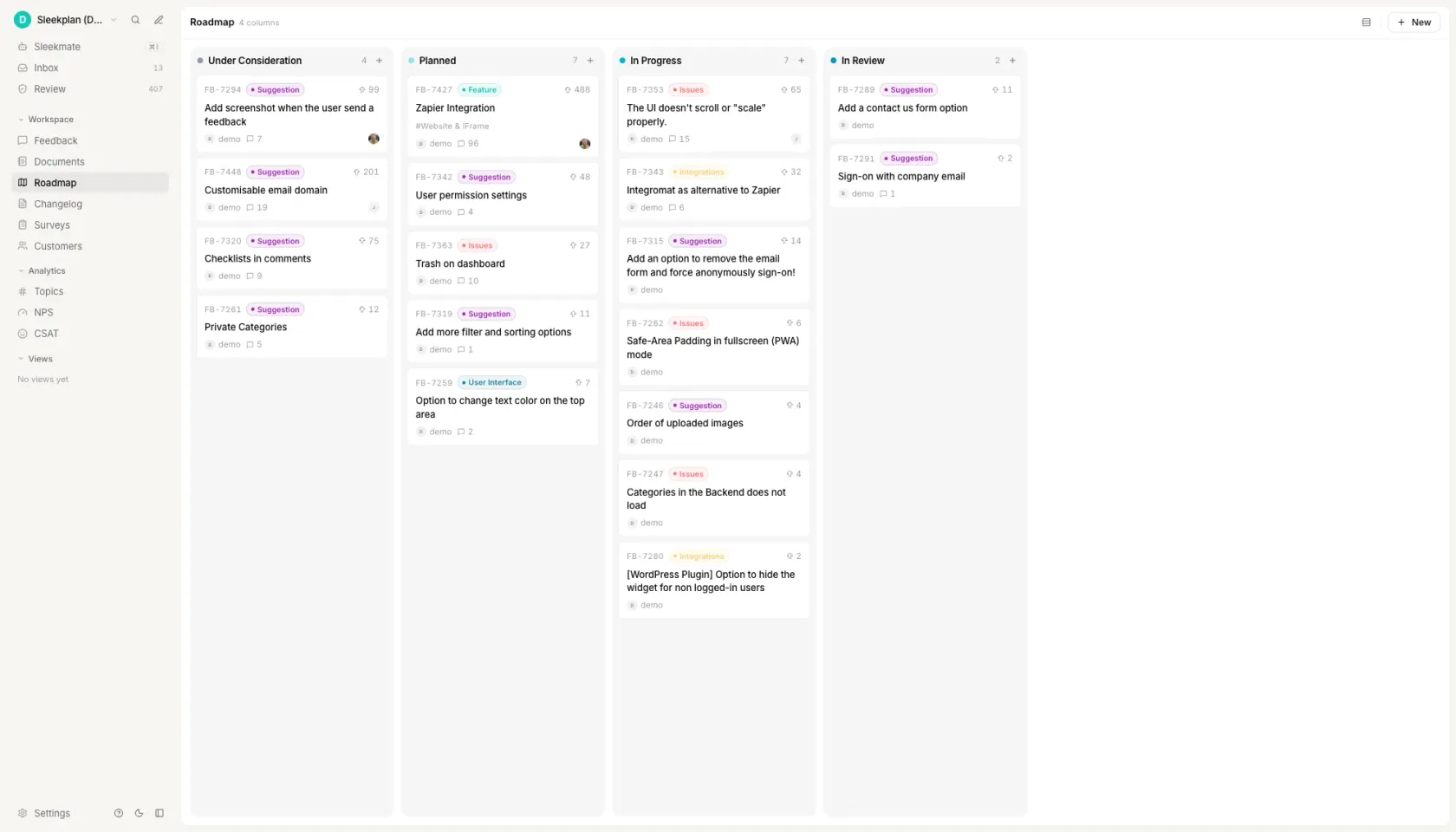
That is the loop Sleekplan closes. Feature requests arrive on one board from the widget, the portal and your support tools, carrying votes and the accounts behind them, so the Must have argument starts from counts and named customers instead of from whoever is most insistent in the room. The items you keep move onto a public roadmap in Planned, In progress and Shipped columns, and the Won't have this time decisions stay visible with a status and a reason, which is the difference between a deferral a customer can read and a request that appears to have vanished. When something ships, the changelog notifies every person who voted for it.
The worksheet on this page is still the right place to do the thinking. What the product replaces is the part after the session: keeping the four categories true as the release moves, and telling the people who asked.
How to use the MoSCoW method
Put every candidate in one list first
One line per item, in one place, before any categorising starts. Sorting a list you are still adding to is how a session runs over: every new item reopens the argument about the size of the Must have bucket. Give each line a rough effort number at the same time, even a t-shirt size converted to points, because step four needs effort and adding it later means reading the whole list again.
Fix the timebox before you sort anything
Name the release date and the capacity out loud, and write both at the top of the worksheet. MoSCoW is a scope-fixing method for a fixed deadline: with no deadline, nothing competes for anything and the four categories collapse into high, medium and low within about ten minutes. If the date is genuinely open, you do not have a MoSCoW problem yet, you have an estimation problem.
Sort each item against one written test
Write the Must have test on the board before the first item: if this is missing on the release date, we do not ship. Then take each item once, at roughly a minute each, and put it in a bucket. Anything that takes longer than a minute goes to a parked column rather than eating the session. A Must have with a workaround is a Should have, however loudly it is argued for, and the test is what lets you say so without it being personal.
Check the Must have share of effort, not of items
Add up the effort in each bucket and take the percentages. DSDM's guidance, from the Agile Business Consortium, is no more than 60% Must have effort, with a Could have pool of around 20% to act as contingency. Counting items instead of effort hides the problem: eight small Musts and one enormous one look like a healthy list and are not. If the Must have share is over 60%, something moves now, in the room, while everyone who can agree to it is present.
Read the Won't haves back, with reasons and dates
Say every Won't have this time out loud, with why and when it will be looked at again. This is the step that stops the list being re-argued in three weeks, and it is the one teams skip because it feels like a formality. Then send the four lists and the effort split within the hour. A categorisation nobody wrote down is a categorisation that gets done again, usually by different people reaching a different answer.
Questions people ask
What is the MoSCoW method of prioritization?
MoSCoW is a method for fixing the scope of a release against a fixed deadline by sorting every item into four categories: Must have, Should have, Could have and Won't have this time. The two lowercase o's only make the acronym pronounceable. It was developed by Dai Clegg in 1994 for rapid application development and, per Wikipedia, first used extensively with DSDM from 2002. It decides what a release must contain; it deliberately says nothing about the order of items inside a category.
What are the four categories of the MoSCoW model?
Must have: the release is not worth shipping without it. The Agile Business Consortium calls these the Minimum Usable SubseT, the set the project guarantees to deliver. Should have: painful to leave out, but a workaround exists. Could have: wanted, cheap to omit, and the first thing dropped when the Must haves run long, which is why DSDM treats it as the contingency pool. Won't have this time: a dated decision to exclude something, recorded with the reason so it is not re-argued next month.
What are common mistakes using the MoSCoW method?
Five recur. Running the session without a fixed deadline, which turns the four categories into high, medium and low. Letting anything important become a Must have, instead of testing whether a workaround exists. Counting items rather than effort, which hides a Must have list that is 80% of the work. Leaving Won't have empty, so the same items come back every planning cycle. And recording no rationale, which means the whole argument is repeated the next time anyone asks why something was a Should.
Is the MoSCoW method still relevant today?
It is relevant wherever the deadline is fixed and the scope can flex, which is what it was built for in 1994, and it is close to useless where the deadline is open. Interest in the term is falling, down roughly 46% year on year in Google Ads search volume measured in September 2026, and the honest reason is that it does one job: it does not rank items, estimate value, or tell you what to build next quarter. Teams that still get value from it usually pair it with a scoring model for the ordering.
What is the difference between RICE and MoSCoW prioritization?
MoSCoW is categorical and RICE is numerical. MoSCoW sorts items into four buckets against a deadline and gives no order inside a bucket, which Wikipedia lists as its first criticism. RICE multiplies reach by impact and confidence, divides by effort, and returns a score that ranks every item against every other. Use MoSCoW to decide what a release must contain, then RICE to order the Should haves and Could haves that are competing for what is left. They answer different questions, so using both is normal rather than redundant.
Your roadmap,
on autopilot.
Free for 30 days. No card, no sales call. Cancel anytime.